

Life Insurance in Retirement: Do You Really Need It?
Do Retirees Really Need Life Insurance? Here’s the Short Answer
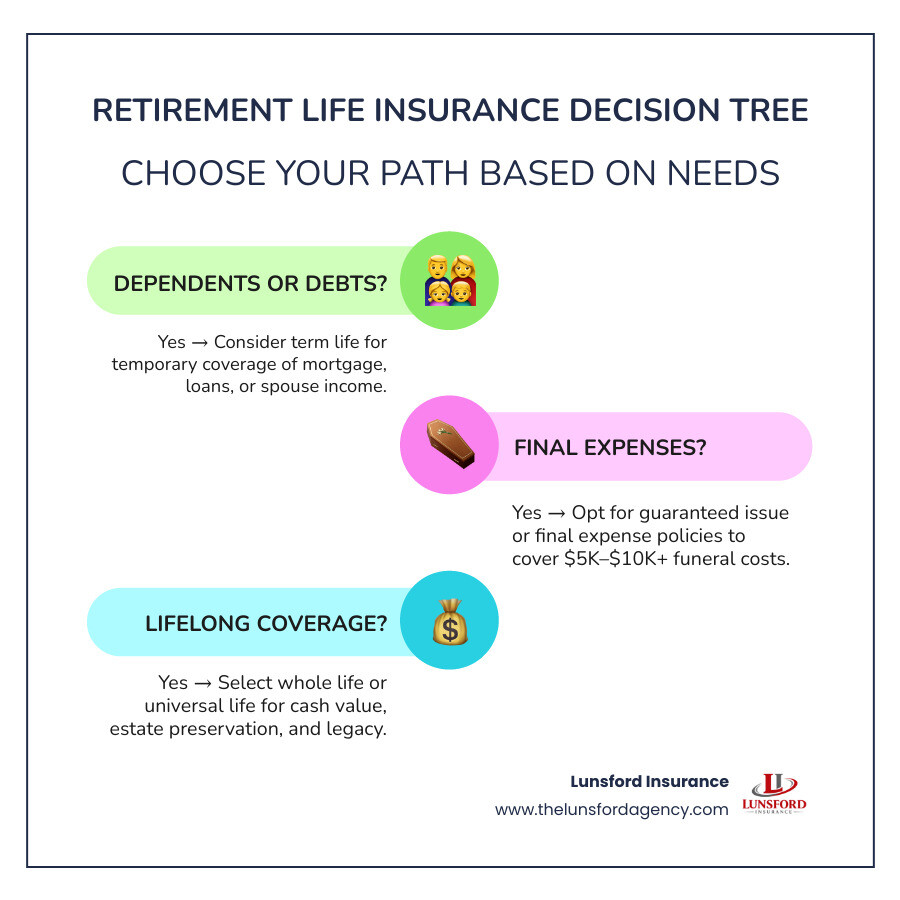
Retirement life insurance options are worth considering if any of the following apply to you:
- You have a spouse who depends on your pension, Social Security, or retirement income
- You have outstanding debts like a mortgage or car loan
- You want to cover final expenses (funerals can cost $5,000–$10,000 or more)
- You want to leave a legacy or gift to children, grandchildren, or charity
- You want to preserve your estate and cover settlement costs
If none of those apply — you’re debt-free, your spouse is financially independent, and you have enough savings — you may not need coverage at all.
For everyone else, the right policy depends on your age, health, budget, and goals. The sections below break down every major option clearly.
Many people assume life insurance is only for younger adults raising families or paying off mortgages. But for retirees, the picture is more nuanced. Your financial obligations may have changed — but they rarely disappear completely. A surviving spouse can face a sharp income drop almost overnight. Final expenses don’t go away. And for many families, a life insurance payout is the simplest, most tax-efficient way to pass something on.
The challenge is that not every policy makes sense at every age. Premiums rise significantly as you get older, coverage options narrow, and some policies that worked during your working years may no longer fit your retirement reality.
I’m Scott Lunsford, owner of The Lunsford Agency in Chillicothe, Ohio, with over 35 years of experience helping pre-retirees and retirees evaluate retirement life insurance options that fit real budgets and real goals. In this guide, I’ll walk you through everything you need to make a confident, informed decision.
Why Seniors Consider Retirement Life Insurance Options
As we transition into our golden years in Ohio, the “why” behind life insurance shifts. It moves from income replacement for a growing family to a strategic tool for estate preservation and finality. We often see clients who realize that while their mortgage might be lower, the cost of dying has skyrocketed.
Funerals aren’t just emotionally taxing; they are expensive. A traditional burial can easily exceed $10,000 when you factor in the service, the casket, and the plot. Even cremations can run up to $5,000. Without a policy in place, these costs often fall directly on grieving children or a surviving spouse who may already be dealing with a reduced household income.
There are many 10 Reasons Why Ohio Residents Need Life Insurance, but for retirees, the focus usually lands on:
- Estate Planning: Providing liquidity to pay off estate taxes or settlement costs so heirs don’t have to sell the family home.
- Debt Coverage: Ensuring a lingering car loan or HELOC doesn’t burden your survivors.
- Legacy Building: Leaving a tax-free “gift” to grandchildren for their education.
- Charitable Giving: Using a death benefit to fund a cause you’ve supported your whole life.

Protecting Your Spouse with Retirement Life Insurance Options
Perhaps the most critical reason to maintain coverage is the “income gap.” When a spouse passes away, the household often loses one Social Security check and potentially a significant portion of pension income.
Statistics show that the financial impact on survivors can be devastating. For example, widows under 55 have been known to see their family income drop by over $15,000 in a single year, with the risk of falling into a low-income bracket nearly tripling. Even for those over 65, the loss of a partner’s “breadwinner” status or retirement benefits can compromise their standard of living. Life insurance acts as a buffer, ensuring the survivor can stay in their home and maintain their lifestyle without dipping into principal savings too early.
Comparing the Best Retirement Life Insurance Options
Choosing the right policy in retirement isn’t about finding the “cheapest” plan—it’s about finding the one that actually pays out when you need it most. As we age, our health becomes a bigger factor in pricing, making it essential to compare different structures.
| Feature | Term Life | Whole Life | Guaranteed Issue |
|---|---|---|---|
| Duration | Temporary (10-30 years) | Lifelong | Lifelong |
| Premiums | Lowest (initially) | Higher (fixed) | Highest per $1,000 |
| Cash Value | None | Yes (builds over time) | Minimal to None |
| Medical Exam | Usually Required | Usually Required | No Exam Required |
| Best For | Temporary debt (mortgage) | Legacy & Estate Planning | Final Expenses/Poor Health |
Term vs. Permanent Retirement Life Insurance Options
When looking at Life Insurance Ohio, you’ll generally choose between “renting” and “owning” your coverage.
Term Life Insurance is like renting. You pay a level premium for a set period (like 10 or 20 years). If you pass away during that time, your beneficiaries get the payout. It’s excellent for covering a debt that has an expiration date, like a 10-year mortgage balance. However, if you outlive the term, the coverage simply ends, or the renewal rates become prohibitively expensive—sometimes increasing exponentially.
Permanent Life Insurance (Whole or Universal) is like owning. It provides lifelong protection as long as premiums are paid. These policies are foundational for wealth building because they accumulate “cash value” on a tax-deferred basis. Some policies even pay out dividends, which you can use to pay your premiums or increase your total death benefit. For retirees, the stability of level premiums in a Whole Life policy is often a huge relief for those on a fixed budget.
Guaranteed Acceptance and No-Exam Policies
What if your health isn’t perfect? Many Ohio seniors worry that a history of heart issues or diabetes will disqualify them. This is where Guaranteed Acceptance policies shine.
These are “simplified underwriting” plans that require no medical exam. In many cases, you aren’t even asked health questions. Approval is often instant. While these policies usually have lower coverage caps (typically $5,000 to $25,000) and a “graded” death benefit (meaning the full amount might not pay out if you pass away within the first two years), they are a lifesaver for covering final expenses. We specialize in these affordable, no-exam senior policies because we believe everyone deserves the peace of mind that their funeral costs are covered.
Managing Existing Policies and Employer Coverage
One of the biggest shocks for new retirees is realizing their employer-provided group life insurance often vanishes the day they stop working. Most group plans only offer a 31 to 90-day window to “convert” the policy to an individual one. If you miss this window, you might lose coverage right when your health makes it harder to get a new private plan.
If you already own a permanent policy, you have several retirement life insurance options to maximize its value while you’re still alive:
- Policy Surrender: You can cancel the policy and take the accumulated cash value, though you may owe taxes on the gains.
- Cash Value Loans: You can borrow against your policy’s cash value tax-free to cover an emergency or a home repair. Just remember, any unpaid loan balance is deducted from the death benefit.
- 1035 Exchanges: This is a powerful IRS-approved move. You can swap the cash value of an old life insurance policy for an annuity without paying immediate taxes. This can turn a “death benefit” into a “living benefit” that provides guaranteed monthly income.
When deciding between an Annuity vs 401k Ultimate Guide, Annuities Ohio can offer a layer of safety that traditional investments can’t match, especially when funded through a policy exchange.
When You Might No Longer Need Coverage
We’ll be the first to tell you: not everyone needs life insurance in retirement. At some point, you may become “self-insured.” This happens when your net worth is high enough that your survivors would be perfectly fine without a payout.
You might consider dropping or reducing your coverage if:
- You are Debt-Free: Your mortgage is paid off, and you have no credit card or car debt.
- Your Heirs are Independent: Your children are grown, successful, and don’t rely on your financial support.
- You Have Ample Savings: You have enough in your ROTH IRA or 401(k) to cover your spouse’s needs and your final expenses.
- Your Funeral is Pre-Funded: You’ve already purchased a prepaid funeral plan or burial plot.
Before you cancel a policy, it’s wise to perform a net worth assessment with a professional. You might find that Supplemental Retirement Plans Ohio offer better ways to protect your assets than a high-premium term policy that is about to expire.
Frequently Asked Questions about Senior Life Insurance
Can I get life insurance after age 75?
Yes! While your options for new 30-year term policies will be limited (most insurers stop offering these around age 70-75), permanent coverage and final expense plans are often available up to age 85. Just keep in mind that premiums will be higher because of the increased statistical risk to the insurance company.
Does Medicare offer life insurance for retirees?
This is a common misconception. Medicare does not provide life insurance. It is strictly health insurance for medical expenses. It does not provide a death benefit or money for funeral costs. To cover those needs, you must look into private retirement life insurance options.
What happens to my cash value if I stop paying premiums?
If you have a permanent policy and stop paying, several things can happen. Your policy might “lapse” and end. However, you might have “non-forfeiture options.” You could use the cash value to buy a “Reduced Paid-Up” policy (a smaller death benefit with no more premiums due) or “Extended Term” insurance. Always check your policy’s surrender value before walking away.
Conclusion: Finding Your Best Path Forward
At Lunsford Insurance, we know that navigating retirement life insurance options can feel like a full-time job. Whether you’re looking to protect your spouse from an income drop, leave a legacy for your grandkids, or simply ensure your final expenses aren’t a burden on your family, we are here to help.
As a specialized brokerage in Ohio, we have strong connections with top-rated carriers, allowing us to find the most affordable, no-exam senior policies available today. You don’t have to guess which plan is right for you. Our goal is to provide you with the same expert, personalized service we’ve given our Chillicothe neighbors for decades.
Ready to see how life insurance fits into your broader financial picture? Contact a Financial Planner Ohio at The Lunsford Agency today for a free, no-obligation consultation. Let us help you find the peace of mind you’ve worked so hard to earn.