

The Secret to Medicaid Compliance in Ohio
Why a Medicaid Compliant Annuity Ohio Strategy Could Save Your Life Savings
A medicaid compliant annuity strategy is one of the most powerful legal tools available to Ohio seniors who need nursing home care but want to avoid losing everything they’ve saved. Long-term care costs in Ohio can exceed $6,400 per month — and without a plan, a lifetime of savings can vanish in just a few years.
Here’s a quick snapshot of what you need to know:
| Key Factor | Details |
|---|---|
| What it is | A lump-sum purchase from an insurance company converted into a fixed income stream |
| Who benefits most | Married couples and individuals facing nursing home costs |
| Ohio asset limit (individual) | $2,000 |
| Community Spouse Resource Allowance (CSRA) | $162,660 |
| Monthly income limit (single) | $2,982/mo |
| Monthly income limit (both spouses) | $5,964/mo |
| Must be | Irrevocable, non-assignable, actuarially sound |
| State of Ohio | Must be named as remainder beneficiary |
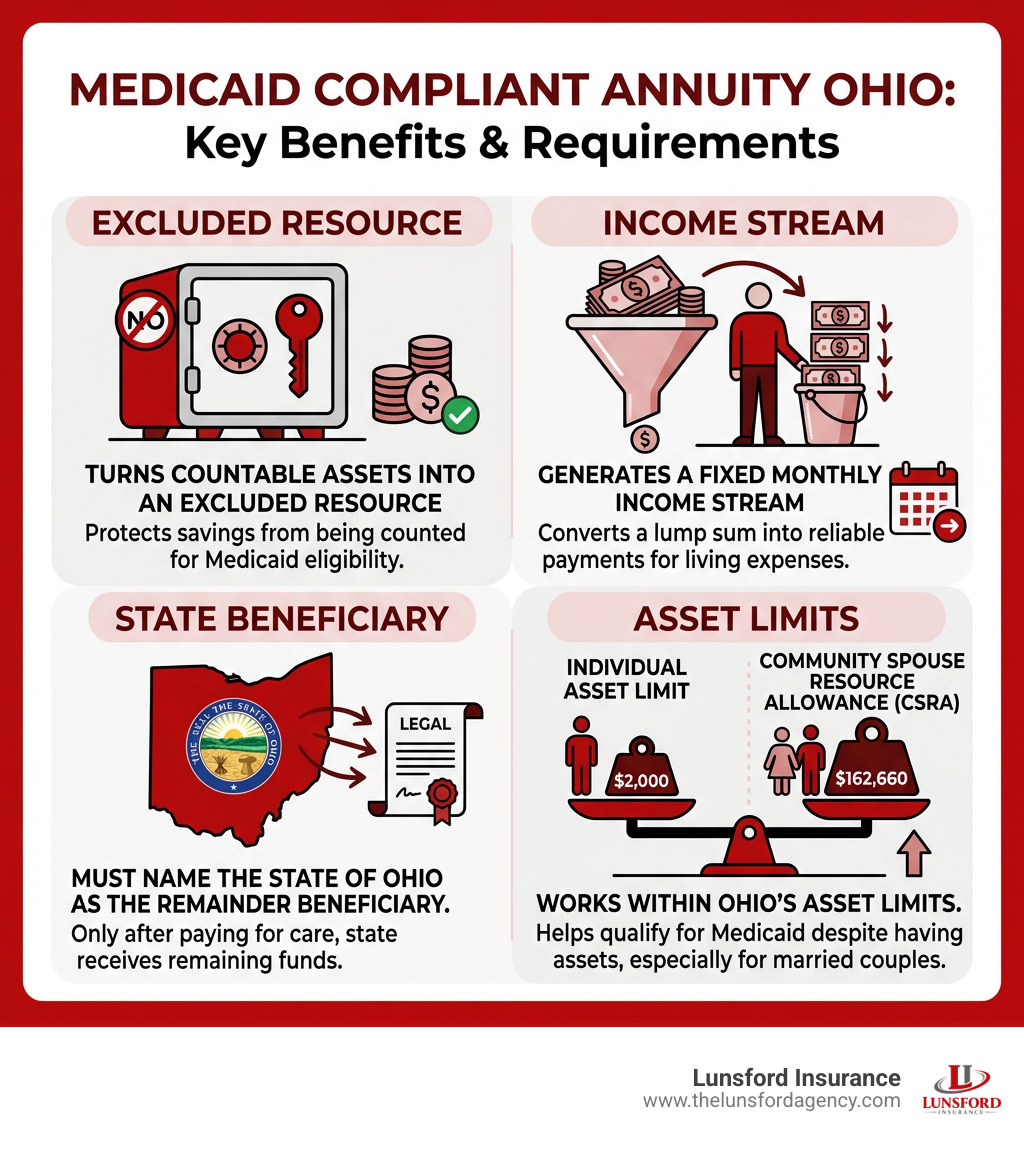
Under Ohio Administrative Code Rule 5160:1-3-05.3, a properly structured annuity is treated as an excluded resource — meaning it doesn’t count against Medicaid’s strict asset limits. The payments it generates are counted as income, not assets.
This distinction matters enormously. It’s the difference between spending down your savings to almost nothing and legally protecting a significant portion of what you’ve built.
I’m Scott Lunsford, founder of The Lunsford Agency and an independent insurance and financial services professional based in Chillicothe, Ohio, with over three decades of experience helping retirees structure annuities for retirement income and Medicaid planning. In this guide, I’ll walk you through exactly how a medicaid compliant annuity works — and how to avoid the costly mistakes that can derail your eligibility.
Understanding the Medicaid Compliant Annuity
When we talk about a medicaid compliant annuity, we are talking about a very specific financial vehicle designed to solve a very specific problem: having too much money to qualify for Medicaid, but not enough money to pay for a nursing home indefinitely.
In Ohio, Medicaid is a “means-tested” program. If you have more than $2,000 in countable assets as an individual, you generally won’t qualify for long-term care assistance. This often leads families into a “spend-down” spiral, where they burn through life savings, CDs, and brokerage accounts just to reach that $2,000 mark.

A Medicaid-compliant annuity (MCA) changes the math. By taking a lump sum of “countable” assets and giving it to a commercial insurance company, you receive a contract for a guaranteed stream of income. Under Rule 5160:1-3-05.3 | Medicaid: annuities., the lump sum is no longer considered a “resource” or an asset. Instead, the monthly checks you receive are treated as “unearned income.”
For more details on how we structure these, you can explore our annuity services. The key is “immediate annuitization.” This isn’t a deferred annuity where the money sits and grows; it is a contract that starts paying out right away, converting a pile of cash into a monthly check.
Legal Requirements under Ohio Administrative Code
You can’t just walk into any bank and buy a standard annuity and expect it to work for Medicaid. Ohio has strict “hoops” you must jump through to ensure the purchase isn’t viewed as an “improper transfer” (a gift that triggers a penalty).
According to ORC §5163.30 Adherence to Ohio’s Medicaid Eligibility Rules, the annuity must meet several technical criteria:
- Irrevocable: You cannot change your mind, cancel the contract, or “cash it out” for a lump sum once it starts.
- Non-assignable: You cannot sell the payment stream to a third party or transfer ownership to someone else.
- Equal Monthly Payments: The payments must be substantially equal. You cannot have “balloon payments” at the end or “deferral periods” where no money is paid out.
- Commercial Issuer: The annuity must be purchased from a commercial insurance company licensed to do business in Ohio. Private “annuities” between family members generally do not count.
Understanding these Annuity Information basics is vital because a single missing clause can result in the state counting the entire purchase amount as a resource, potentially disqualifying you from benefits.
Beneficiary Rules for a Medicaid Compliant Annuity in Ohio
One of the most important rules involves who gets the money if the person receiving the payments passes away. To be compliant, the annuity must name the State of Ohio as the remainder beneficiary.
Under Rule 5160:1-6-06.1 – Ohio Administrative Code, the state must generally be in the first position to receive any remaining funds, up to the total amount of medical assistance paid on behalf of the individual.
There is a slight exception for married couples: the “community spouse” (the one not in the nursing home) can be named in the first position. However, if that spouse then passes away or if there are still funds left, the State of Ohio must be named in the next position. This “payback” provision is what makes the federal government and the state allow this strategy in the first place.
Actuarial Soundness for a Medicaid Compliant Annuity in Ohio
The term “actuarially sound” sounds like something only an accountant could love, but it’s the heartbeat of a medicaid compliant annuity in Ohio. Essentially, it means the annuity must be designed to pay back the entire principal and interest within the individual’s statistical life expectancy.
Ohio uses the SSA’s (Social Security Administration) life expectancy table to determine these limits. For example, if the table says a 80-year-old man has a life expectancy of 7 years, the annuity term cannot be 10 years. If the term is longer than the life expectancy, the state considers the “extra” years to be a gift to the heirs, which creates a penalty.
When comparing an Annuity vs 401k Ultimate Guide to Choosing for Retirement, while a 401k is a countable asset, the annuity—when structured correctly—protects the principal from being drained by the nursing home.
Protecting Spousal Assets and Income Limits
In our experience at The Lunsford Agency, we see the biggest benefits of these annuities when helping “community spouses”—the husband or wife who stays at home while their partner enters care. Ohio law wants to prevent “spousal impoverishment,” meaning they don’t want the healthy spouse to end up in poverty just to pay for the other’s care.
| Limit Type | 2025/2026 Ohio Medicaid Limit |
|---|---|
| Individual Asset Limit | $2,000 |
| Community Spouse Resource Allowance (CSRA) | $162,660 |
| Single Applicant Income Limit | $2,982 / month |
| Combined Couple Income Limit | $5,964 / month |
If a couple has $300,000 in savings, the community spouse is only allowed to keep the CSRA of $162,660. The remaining $137,340 would normally have to be “spent down.” However, by taking that excess $137,340 and purchasing a medicaid compliant annuity in Ohio, that money is converted into an income stream for the community spouse. The “asset” disappears, the spouse gets more monthly income to live on, and the nursing home resident qualifies for Medicaid.
This is a key part of long-term care insurance in Ohio planning. While insurance is best for pre-planning, the annuity is the “crisis planning” tool we use when the nursing home stay is already happening.
Spousal Protections and the Deficit Reduction Act
The rules we follow today were largely shaped by the Deficit Reduction Act (DRA) of 2005. According to the Centers for Medicare and Medicaid Services, the DRA was designed to close “loopholes” that allowed people to give away money to family members just to qualify for Medicaid.
However, court cases like Hughes v. McCarthy in Ohio have solidified the right of a community spouse to use a Medicaid-compliant annuity to protect assets. The courts ruled that as long as the annuity meets the federal and state requirements, it is a valid way to preserve a spouse’s standard of living while the institutionalized spouse receives care.
Avoiding Improper Transfers and Planning Pitfalls
The biggest danger in this process is the “Look-Back Rule.” Ohio Medicaid looks back at the last five years of your financial history. If they see you gave away $50,000 to a grandchild or bought a non-compliant annuity, they will slap you with a “restricted coverage period”—a penalty where Medicaid refuses to pay for care.
In Ohio, this penalty is calculated using a “penalty divisor.” Currently, the divisor is $6,327. This means for every $6,327 you “improperly transferred,” you lose one month of Medicaid coverage. If you buy a $100,000 annuity that isn’t compliant, you could be looking at over 15 months of paying for the nursing home out of your own pocket.
This is why “crisis planning” requires such precision. You can see more about these risks in our Category: Long-term Care section.
Final Expense Insurance as a Planning Tool
While annuities protect large sums, we often recommend “Final Expense Insurance” as a complementary tool. This is often part of the “spend-down” process because an irrevocable burial contract is an exempt asset in Ohio.
Our 4-step process for final expense is simple:
- Choose Coverage: Select a benefit amount (typically $3,000 to $50,000).
- Select Policy Type: We offer simplified issue (some health questions) or guaranteed issue (no medical exams).
- Pay Fixed Premiums: Your rates will never increase.
- Beneficiary Receives Payout: The lump sum goes directly to funeral or medical costs.
These policies offer life-long coverage, and while a 2-year waiting period may apply for certain health conditions, they are a vital way to ensure your family isn’t burdened with funeral costs while your other assets are tied up in Medicaid rules.
Frequently Asked Questions about Ohio Medicaid Annuities
Can I cancel a Medicaid-compliant annuity once it is purchased?
No. To be a medicaid compliant annuity, the contract must be irrevocable. This means you cannot “change your mind” and ask for the money back. You are locked into the monthly payment schedule for the duration of the term. This is why we always ensure our clients have other liquid assets (within the allowed limits) for emergencies.
What happens if the annuitant dies before the term ends?
If the person receiving the payments passes away before the annuity has paid out all the funds, the “remainder beneficiary” clause kicks in. As required by Ohio law, the State of Ohio will be reimbursed for the medical assistance they provided. If there is still money left after the state is paid back, those funds can then go to your named heirs (like children or grandchildren).
How does Ohio calculate the penalty for non-compliant annuities?
If an annuity doesn’t meet all the requirements (e.g., it’s revocable, or it doesn’t name the state as beneficiary), Ohio treats the purchase as an “improper transfer” for less than Fair Market Value. They take the total amount used to buy the annuity and divide it by the penalty divisor (currently $6,327). The result is the number of months you are ineligible for Medicaid.
Conclusion
Navigating Medicaid in Ohio doesn’t have to be a nightmare. A medicaid compliant annuity can be the “secret” that keeps a spouse in their home and preserves a family’s hard-earned legacy. At Lunsford Insurance, we specialize in this type of personalized brokerage. We aren’t just selling a product; we are coordinating with your legal needs to ensure every “i” is dotted and every “t” is crossed according to Ohio Administrative Code.
Whether you are in Chillicothe, or anywhere else in Ohio, we are here to help you navigate these limits—from the $162,660 CSRA to the $2,982 individual income cap. Don’t wait until your savings are gone to start the conversation.
Secure your future with a Medicaid Compliant Annuity in Ohio by contacting us today for a personalized review of your situation.