

Don’t Leave Your Family the Bill with Ohio Final Expense Plans
Summary
The Ohio Life & Health Insurance Guaranty Association (OLHIGA) is a state-mandated organization that provides a layer of protection to certain policyholders if a licensed insurance company fails. It is designed to help Ohio residents who hold covered life insurance, health insurance, or annuity contracts with member insurers. In practical terms, OLHIGA is a safety net where insurance companies pool resources to pay claims if one fails.
This protection does not replace careful insurance planning, and it does not apply to every policy or every type of insurer. Instead, it typically becomes relevant only after a member insurer has been declared insolvent and a court has entered an order of liquidation. At that point, OLHIGA may help continue coverage, arrange a transfer of policies, or pay covered claims up to the limits set by Ohio law.
For many consumers, the most important point is that guaranty association protection is tied to state law and to the type of contract involved. Life insurance, health insurance, and annuities may be treated differently, and coverage limits may vary depending on the benefit at issue. Burial insurance is considered life insurance, not an annuity, for purposes of understanding this framework.
OLHIGA protection is not the same as federal deposit insurance, and it is not intended to be used as a reason to choose one insurer over another. Instead, it functions as a back-end consumer protection mechanism that may help reduce disruption if an insurer cannot meet its obligations. Coverage, eligibility, and limits depend on the specific product, situation, and Ohio regulations.
OLHIGA Definition & Purpose

OLHIGA is a safety net where insurance companies pool resources to pay claims if one fails. In simple terms, this means that if an insurance company becomes insolvent and cannot pay what it owes, the association may step in to help protect covered Ohio policyholders up to certain limits.
The association exists under Ohio law and is funded by assessments on member insurers rather than by general tax dollars. Its purpose is to reduce hardship for residents when a licensed life or health insurer becomes financially impaired and is later ordered into liquidation. Instead of leaving policyholders entirely on their own, the system typically provides an organized process for handling covered obligations.
OLHIGA may assist with several kinds of contracts, including life insurance policies, health insurance policies, and annuity contracts issued by insurers licensed in Ohio. In some cases, the association may support ongoing coverage through a transfer to another insurer. In other cases, it may pay claims directly or provide benefits subject to statutory limits. When consumers hear the phrase Ohio annuity guarantee, they are often referring generally to this guaranty association protection for covered annuity obligations. For more background on how state guaranty associations work across the country, see the National Organization of Life & Health Insurance Guaranty Associations (NOLHGA) website.
It is also important to understand what OLHIGA is not. It is not a regulator, it is not an insurance company that sells coverage to the public, and it is not a substitute for reviewing an insurer’s financial strength before buying a policy. The guaranty association is a legal protection mechanism that typically becomes relevant only after insolvency occurs.
Because the association operates under detailed statutory rules, outcomes may differ based on the contract, the owner, the beneficiary, and the state responsible for the claim. Coverage, eligibility, and limits depend on the specific product, situation, and Ohio regulations.
Residency & Eligibility
Eligibility for OLHIGA protection typically begins with residency and the status of the insurer. In general, an individual usually must be a resident of Ohio at the time the insurer is determined to be insolvent for OLHIGA to be the responsible association. If the policyholder lives in another state, that state’s guaranty association may be the one that reviews the claim instead.
Residency matters because guaranty association protection is organized on a state-by-state basis. Even when an insurer operates in multiple states, the association that responds to a covered claim is typically determined by where the contract owner resides, along with other legal factors that may apply to the contract. This is one reason state of residence is often central in insolvency proceedings.
Eligibility also generally depends on whether the insurer was licensed in Ohio. OLHIGA protection usually applies only to policies and contracts issued by member insurers that were authorized to do business in the state. If a policy came from a company not licensed in Ohio, the policy may fall outside the association’s protection.
The type of policy also matters. Covered products may include life insurance, certain health insurance benefits, and annuities, but the exact scope of protection may vary. Burial insurance, for example, is treated as life insurance rather than as an annuity. Group coverage, ownership structure, and where a contract was issued may also affect how the law applies.
Consumers should also keep in mind that not every person connected to a policy is necessarily the one whose residency controls. Depending on the contract, the relevant party may be the owner, certificate holder, or another legally defined person. These details are usually reviewed during the insolvency process rather than at the time the policy is purchased.
Coverage, eligibility, and limits depend on the specific product, situation, and Ohio regulations.
Coverage Limits (Verified Caps)
OLHIGA protection is subject to maximum limits established by Ohio law rather than the full amount shown on every policy. For life insurance death benefits, the protection limit is typically $300,000 per person. For the cash surrender or withdrawal value of life insurance, lower sublimits may apply depending on the benefit involved.
For annuities, the present value of covered benefits is typically protected up to $250,000 per person. Consumers sometimes refer to this generally as the Ohio annuity guarantee, although the legal protection comes through the guaranty association structure and the limits set by statute. Whether a benefit is measured by present value, cash value, or death benefit may depend on the contract language and the governing law.
Health insurance benefits may be subject to separate caps that differ from life insurance and annuity limits. In practice, that means a consumer should not assume one number applies to every kind of policy. The amount of protection typically depends on the category of coverage and the specific benefit being claimed.
These caps are especially important because they show that guaranty association coverage is limited protection, not unlimited replacement of all insurer obligations. Many policyholders may find that their covered values fall within the statutory limits, while others with larger policies or contracts may have only partial protection. The association’s role is to provide statutory coverage up to the applicable cap, not to recreate every contract exactly as written in all circumstances.
As a simple classification point, burial insurance is life insurance, not an annuity. That means it is generally evaluated under the life insurance side of the coverage framework rather than the annuity side.
Coverage, eligibility, and limits depend on the specific product, situation, and Ohio regulations.
Exclusions
Not every policy or entity falls within OLHIGA protection. Key exclusions typically include:
- Policies issued by companies not licensed to do business in Ohio.
- Policies issued by fraternal benefit societies.
- Health Maintenance Organizations (HMOs).
- Self-funded employer plans.
- The portion of a policy or contract that is not guaranteed by the insurer.
These exclusions matter because consumers sometimes assume that any product related to life, health, or retirement planning is automatically covered by the guaranty association. In reality, OLHIGA protection usually applies only when the insurer, product, and benefit all fit within Ohio’s statutory framework.
For variable or market-linked products, the association typically does not protect investment losses or portions of benefits that depend on market performance rather than on insurer guarantees. In the same way, employer arrangements that are self-funded are generally outside guaranty association coverage because there is no licensed insurer standing behind the benefit in the same way as a traditional insurance contract.
Because exclusions can be technical, the most reliable approach is to review the policy form, the insurer’s licensing status, and the type of benefit involved if an insolvency occurs. Coverage, eligibility, and limits depend on the specific product, situation, and Ohio regulations.
Insolvency Process
When an insurance company is declared insolvent by a court, the liquidation process is initiated. OLHIGA typically works with the court-appointed liquidator to protect covered policyholders and beneficiaries as claims are reviewed. The exact timeline may vary based on the insurer’s records, the type of policies involved, and the complexity of the insolvency.
In many cases, policyholders do not need to start from scratch or immediately replace their coverage on their own. The association may help continue benefits for a period of time, facilitate the transfer of covered policies to a financially stable insurer, or arrange for covered claims to be paid under the statutory limits. Which approach is used typically depends on what is most practical in the liquidation.
Consumers may receive notices explaining what happened, what benefits may continue, and what steps, if any, they need to take. Beneficiaries and policy owners may be asked to submit claim forms or supporting documents, especially when a death benefit, annuity payment, or other contractual obligation is due after the insolvency order. Delays may occur, but the purpose of the process is to create an orderly method for handling covered obligations rather than leaving policyholders without any structure.
The insolvency process is also coordinated through a legal framework, not through informal company decisions. Courts, liquidators, state regulators, and guaranty associations each have a role. OLHIGA typically addresses covered Ohio obligations, while other state guaranty associations may become involved when policyholders or contract owners reside elsewhere.
Although the process may feel unfamiliar to consumers, the central idea is straightforward: when a member insurer fails, the guaranty association system may help preserve covered benefits up to the applicable limits. Coverage, eligibility, and limits depend on the specific product, situation, and Ohio regulations.
Local Authority

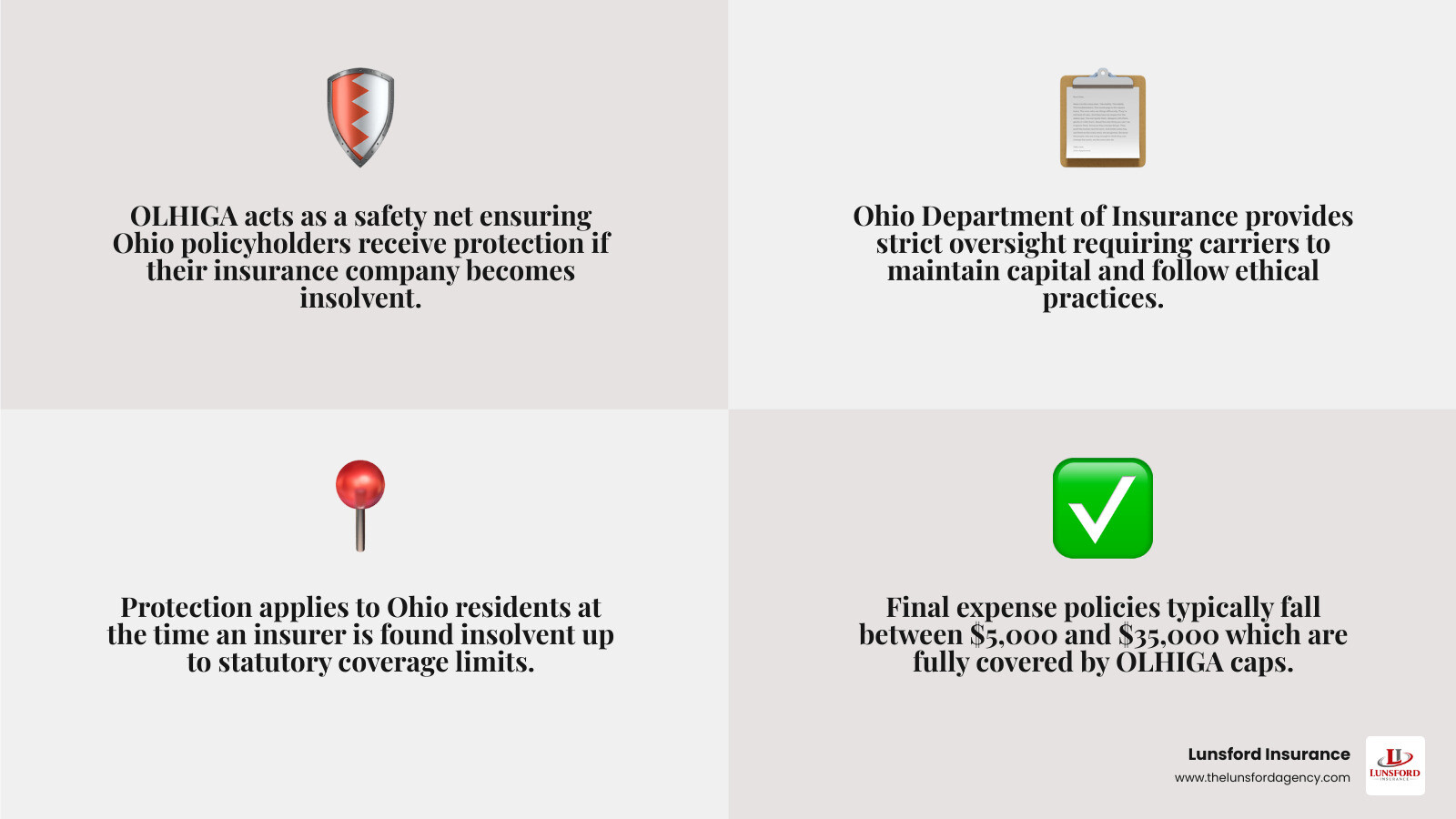
The Ohio Department of Insurance (ODI) is the primary state regulator overseeing insurers that do business in Ohio. Its role typically includes licensing insurers, monitoring financial condition, reviewing compliance, and taking regulatory action when necessary. This oversight is separate from OLHIGA, but the two are related because guaranty association protection usually becomes relevant only when regulatory and court processes determine that an insurer is insolvent.
In practical terms, ODI works on the front end of consumer protection by supervising insurers before a failure occurs. OLHIGA works on the back end by helping address covered obligations after an insolvency and liquidation order. Understanding this distinction can help consumers see why both systems matter: one is focused on regulation and prevention, while the other is focused on limited statutory protection if prevention is not enough.
ODI may also provide public information about insurer licensing and about the liquidation process when a company fails. Consumers who want to confirm whether an insurer is licensed in Ohio or who need general regulatory information may look to the department as the authoritative state source. Questions about a specific insolvency, however, may involve both the department and the guaranty association, depending on the issue.
Together, Ohio’s regulatory oversight and guaranty association framework are intended to support policyholders when a licensed insurer runs into severe financial trouble. Still, guaranty association protection has limits and exclusions, and it is not a substitute for understanding the policy you own.
Coverage, eligibility, and limits depend on the specific product, situation, and Ohio regulations.