

How to Find Affordable Final Expense for Seniors
Why Affordable Final Expense Coverage Matters for Ohio Seniors
Affordable final expense seniors insurance is one of the most practical ways to protect your family from unexpected end-of-life costs — without leaving them with a financial burden during an already difficult time.
Here is a quick summary of what you need to know:
| Question | Quick Answer |
|---|---|
| What does it cost? | $25–$135/month depending on age, gender, and coverage amount |
| How much coverage do you need? | $10,000–$25,000 covers most funeral and final expenses |
| Do you need a medical exam? | No — simplified and guaranteed issue plans require none |
| Who qualifies? | Most seniors ages 50–85, even with health conditions |
| Are payouts tax-free? | Yes — death benefits go directly to your beneficiary tax-free |
| Do premiums ever go up? | No — rates lock in when you buy |
Funerals in Canada and the U.S. are expensive — and getting more so. The average burial in 2024 costs around $8,300, and cremation runs roughly $6,300. Meanwhile, the government’s help is minimal. The Canada Pension Plan offers a one-time death benefit of just $2,500 maximum — nowhere near enough to cover full costs. In the U.S., there is no equivalent federal lump-sum benefit for most retirees.
Without a plan in place, your family is left covering those costs out of pocket — often while grieving.
I’m Scott Lunsford, founder of The Lunsford Agency in Chillicothe, Ohio, with over 35 years of experience helping retirees and pre-retirees find affordable final expense seniors coverage that fits their budget and health situation. I’ll walk you through everything you need to know to make a confident, informed decision.
Understanding Affordable Final Expense Seniors
When we talk about affordable final expense seniors insurance, we are essentially talking about a specialized type of whole life insurance. Unlike those massive million-dollar policies you see in movies, final expense insurance is designed with a very specific, modest goal: covering the bills that arrive when a person passes away.
Think of it as a “safety net” policy. It isn’t meant to replace 30 years of income or pay off a five-bedroom mansion. Instead, it’s meant to ensure that your kids or spouse don’t have to pass a hat around or start a crowdfunding page just to pay for a casket or a memorial service. Because it is a whole life policy, it remains in effect for your entire life, as long as the premiums are paid.
How Affordable Final Expense Seniors Policies Work
These policies are remarkably straightforward, which is why we love them for our Ohio neighbors. Here is the basic “life cycle” of a policy:
- Fixed Premiums: You choose a coverage amount (usually between $5,000 and $25,000). Your monthly rate is set based on your age and health at the time you apply. The best part? That rate is locked in. It will never go up, even if you live to be 105.
- Cash Value Accumulation: Over time, these policies build a small amount of cash value. While we don’t recommend buying these as an “investment,” it is nice to know that in an absolute emergency, you might be able to take a loan against that value.
- The Payout: When you pass away, the insurance company pays a lump sum directly to your chosen beneficiary (like a spouse or child).
- Tax-Free Benefit: In almost all cases, this death benefit is paid out tax-free. Your family gets every penny of the $10,000 or $20,000 you planned for them.
- No Strings Attached: While we call it “burial insurance,” the beneficiary can actually use the money for anything. If the funeral is paid for and there is $5,000 left over, they can use it to pay off your final credit card bill, medical expenses from the hospital, or even travel costs for family members coming to the service.
Who Needs Final Expense Coverage?
We often see folks in Chillicothe and across Ohio who are in a “financial middle ground.” They have a steady pension or Social Security, their house is mostly paid off, but they don’t have $10,000 to $15,000 sitting in a liquid savings account specifically for funeral costs.
Affordable final expense seniors insurance is best suited for:
- Seniors with Limited Savings: If your savings are tied up in your home or a retirement account that isn’t easily accessible, a quick-paying insurance policy is a godsend for your family.
- Those with Health Conditions: If you’ve been turned down for traditional life insurance because of diabetes, heart issues, or high blood pressure, final expense policies are much more forgiving.
- Seniors Wanting to Protect a Legacy: You’ve worked hard for what you have. You don’t want your final act to be leaving a debt for your children to settle.
- Individuals with Small Debts: If you have a small car loan or a few thousand dollars in credit card debt, this coverage can wipe those out so your heirs inherit your assets “clean.”
Comparing Policy Types: Simplified vs. Guaranteed Issue
One of the biggest hurdles seniors face is the “medical exam.” Nobody wants a stranger coming to their house to draw blood or ask them to hop on a treadmill. The good news? Most affordable final expense seniors plans skip the exam entirely.
However, there are two main “paths” to getting covered, and which one you choose depends on your health.
Finding Affordable Final Expense Seniors Coverage Without a Medical Exam
We generally categorize these “no-exam” policies into two buckets:
1. Simplified Issue Life Insurance
This is usually “Plan A.” You don’t take a physical exam, but you do answer a few basic health questions (usually “Yes/No”). The insurance company will also do a quick check of your prescription history.
- Pros: If you are in relatively good health, you get lower rates and immediate coverage. This means if you sign up on Monday and pass away on Friday, the full benefit is paid.
- Cons: You can be declined if you have very serious recent health events (like a stroke in the last year or active cancer).
2. Guaranteed Issue (Guaranteed Acceptance)
This is “Plan B,” and it is exactly what it sounds like: you cannot be turned down. There are no health questions and no medical exams.
- Pros: Perfect for seniors with serious chronic illnesses or those who have been declined elsewhere.
- Cons: Because the insurance company is taking a big risk, the premiums are higher, and there is almost always a “waiting period.”
| Feature | Simplified Issue | Guaranteed Acceptance |
|---|---|---|
| Medical Exam | No | No |
| Health Questions | Yes (Basic) | No |
| Approval Time | Minutes to Days | Instant |
| Cost | More Affordable | Higher Premiums |
| Waiting Period | None (Immediate) | 2-Year Graded Benefit |
| Best For | Average Health | Serious Health Issues |
The Role of Graded Death Benefits
If you opt for a guaranteed acceptance policy, you need to understand the “Graded Death Benefit” or waiting period. Since the company isn’t asking about your health, they protect themselves by saying: “If you die from natural causes within the first two years, we won’t pay the full $10,000 yet.”
Instead, if a natural death occurs during those first 24 months, your family usually receives a refund of all the premiums you paid, plus a little extra (often 10% interest).
The “Accident” Exception: Even during the waiting period, if you pass away due to an accident (like a car crash), the policy almost always pays the full amount immediately. Once you hit the two-year mark, you are fully covered for everything, including natural causes.
The Real Cost of Funerals and Burial in 2025
Let’s talk numbers. Why do we emphasize affordable final expense seniors coverage so much? Because the “cost of dying” is rising faster than the general rate of inflation. In Ohio, we see families shocked by the itemized bill from a funeral home.
According to 2024 and 2025 projections from the National Funeral Directors Association, the national median cost of a funeral with a viewing and burial is approximately $8,300. If you add a vault (which many cemeteries require), that number jumps over $10,000.
Even cremation, which used to be the “cheap” alternative, has seen price hikes. A cremation with a memorial service now averages around $6,300.
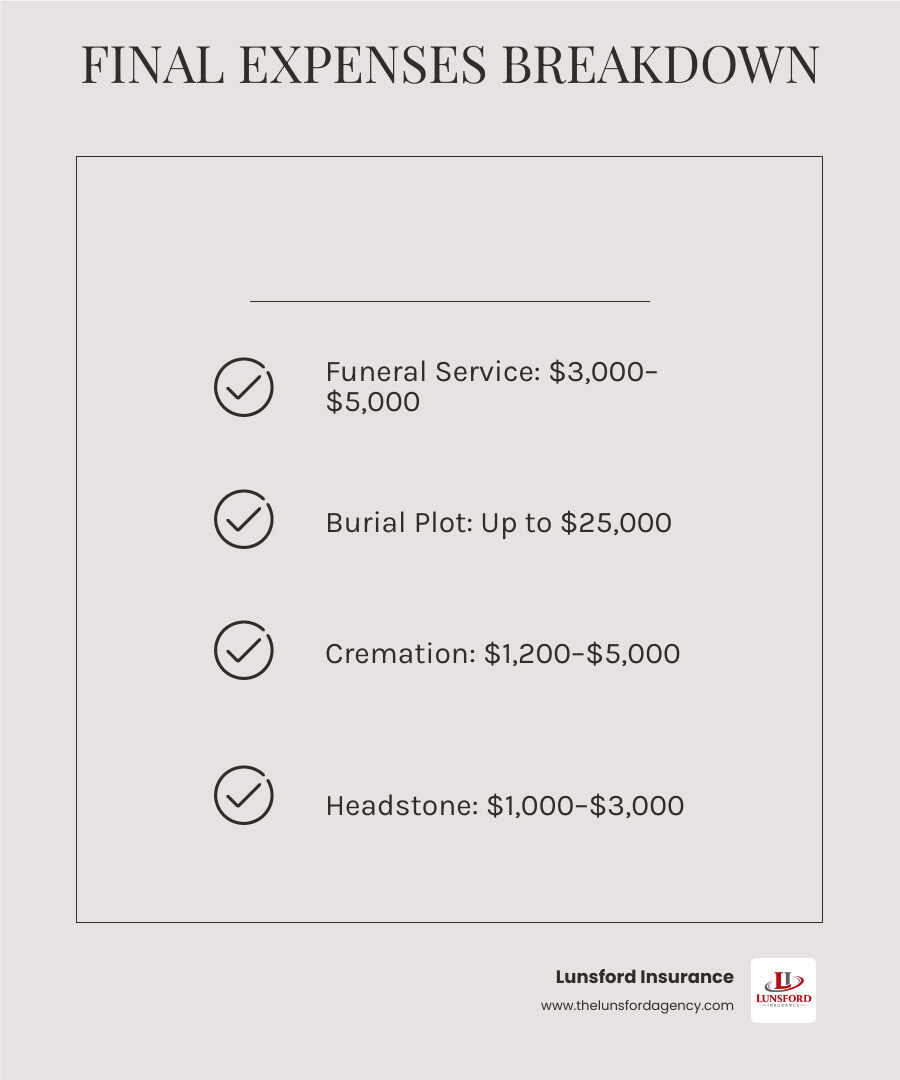
Average Costs by Service Type
To help you choose the right coverage amount, here is a breakdown of what your family might be facing:
- Direct Cremation: $1,200 – $3,500. This is the most basic option with no service or viewing.
- Traditional Burial: $8,000 – $12,000+. This includes the casket, embalming, hearse, and funeral home staff.
- Cemetery Plot: $1,000 – $4,000. In some high-demand areas or city cemeteries, a single plot can actually exceed $25,000, though Ohio rates are generally more grounded.
- Headstone/Marker: $1,000 – $3,000.
- Flowers and Obits: $500 – $1,000.
When you add these up, you can see why many of our clients choose a policy in the $15,000 range. It covers the service and leaves a little “cushion” for those unexpected final bills. You can find more info about life insurance Ohio services on our website to help narrow down these local costs.
Advantages of Final Expense Insurance
You might be wondering, “Why not just pre-pay the funeral home?” While pre-paying is an option, affordable final expense seniors insurance offers several advantages:
- Flexibility: A pre-paid plan locks you into one funeral home. If you move from Chillicothe to be closer to your grandkids in another state, that contract might not follow you. Insurance goes wherever you go.
- Portability: Your policy is yours. It isn’t tied to a specific business.
- Speed: Insurance companies that specialize in final expense are built for speed. They know the family needs the money now to pay the funeral home. Payouts often happen within days of submitting a death certificate.
- Covers More Than Just the Casket: As we mentioned, the money can pay for medical bills, travel for family, or even estate taxes.
Frequently Asked Questions about Senior Burial Insurance
We get a lot of questions at the agency. Here are the most common ones we hear from Ohio seniors looking for affordable final expense seniors coverage.
Can I get coverage if I am over 80?
Absolutely. While many term life policies cut off at age 70 or 75, final expense insurance is built for the “golden years.” Most of our carriers offer coverage up to age 85. Even if you are 82 and have a few health “hiccups,” we can almost always find a guaranteed acceptance plan that will take you. The premiums will be higher than they would be for a 60-year-old, but the peace of mind is just as valuable.
Do premiums increase as I get older?
No. This is a common fear, especially for those on a fixed income. With the whole life policies we provide, your rate is locked in for life. If you start a policy at age 70 for $60 a month, you will still be paying $60 a month when you are 90. Your benefits also never decrease. It is a stable, predictable line item in your budget.
How quickly do beneficiaries receive the payout?
In the insurance world, final expense claims are the “fast-track” items. While a standard million-dollar policy might take months of investigation, a $10,000 burial policy is usually processed as soon as the company receives a certified copy of the death certificate. Many of our top-rated carriers aim to have the check in the beneficiary’s hands (or the funds in their bank account) within 2 to 5 business days.
Does the government help with these costs?
In the U.S., the “death benefit” from Social Security is a measly $255, and it is only available to a surviving spouse or child who meets strict criteria. It hasn’t been updated in decades and won’t even cover the cost of a basic urn. This is why private insurance isn’t just a “luxury” — for most of us, it’s a necessity to avoid leaving a debt behind.
How to Choose the Right Coverage Amount
Selecting the right amount for affordable final expense seniors insurance is a balancing act. You want enough to be helpful, but you don’t want a premium that pinches your monthly budget too hard.
Here is a simple 3-step process we use:
- Decide on the “Big Stuff”: Do you want a traditional burial or cremation? That is a $4,000 difference right there.
- Add the “Small Stuff”: Think about $2,000 for final medical co-pays and maybe $1,000 for an “emergency fund” for your kids to handle travel or utility bills during the transition.
- Check Your Budget: If a $20,000 policy is $100 a month and that feels too tight, look at a $10,000 policy for $55. Some coverage is always better than no coverage.
Conclusion
At Lunsford Insurance, we believe that every Ohio senior deserves the dignity of a planned-for ending. We specialize in finding affordable final expense seniors policies that don’t require needles, doctors, or complicated exams.
Whether you are in Chillicothe or anywhere else in the Buckeye State, our goal is to provide that “personalized brokerage” touch. We aren’t tied to just one insurance company; we work with a wide range of strong carriers to find the one that gives you the best rate for your specific age and health.
Don’t leave your family guessing or stressing. Taking five minutes today to get a quote can save them weeks of financial heartache later. You can secure your family’s future with life insurance Ohio by reaching out to us for a no-pressure, friendly conversation about your options.
We’ve helped thousands of seniors find peace of mind. We’d be honored to help you, too.