

How to Master Long Term Care Planning in Ohio
Why Retirement Long Term Care Planning Could Be the Most Important Decision You Make
Retirement long term care is the ongoing assistance people need with basic daily activities — like bathing, dressing, and eating — when aging, illness, or cognitive decline makes those tasks difficult to manage alone.
Here is a quick overview of what that means for your retirement plan:
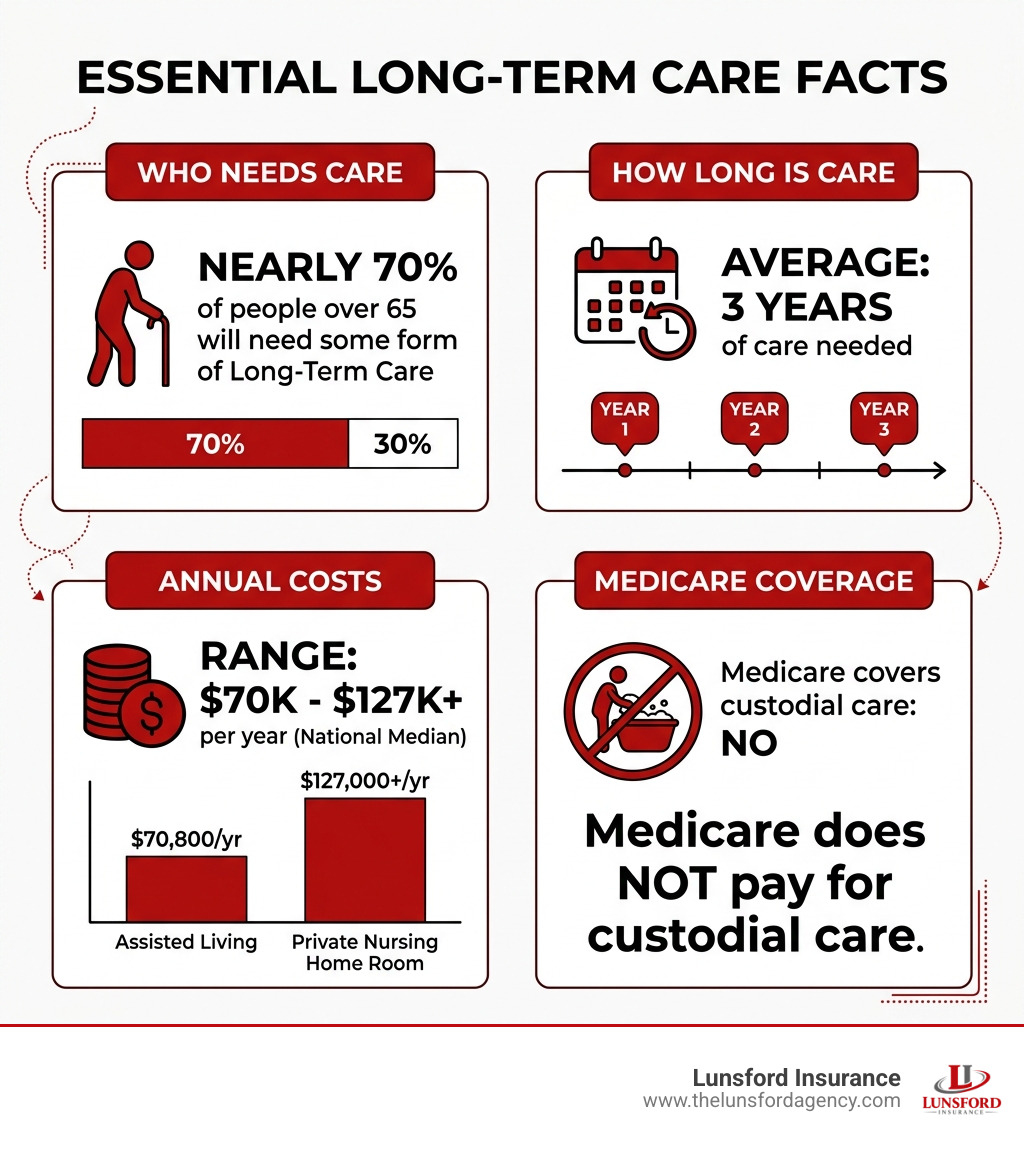
- Who needs it: Someone turning 65 today has nearly a 70% chance of needing some form of long-term care
- How long: The average person uses long-term care services for about 3 years; women average 3.6 years, men average 2.5 years
- What it costs: 2024 national median costs range from roughly $70,800 per year for assisted living to over $127,000 per year for a private nursing home room
- What Medicare covers: Very little — Medicare does not pay for custodial care, which is the type of help most people eventually need
- What you can do: Options include long-term care insurance, hybrid life insurance policies, Health Savings Accounts (HSAs), and dedicated personal savings
The financial stakes are real. The average 65-year-old who needs long-term care can expect to spend around $245,400 in today’s dollars over the course of their care — and that figure climbs sharply for those with longer needs. Yet only 44% of Americans have made any plan for it, even though 61% expect to need it.
That gap between expecting a need and actually planning for it is exactly where financial harm tends to happen — to retirement savings, to families, and to the quality of care people receive.
I’m Scott Lunsford, owner of The Lunsford Agency in Chillicothe, Ohio, with over three decades of experience helping Ohio retirees and pre-retirees build sound strategies around retirement long term care, life insurance, and income protection. In this guide, I’ll walk you through everything you need to know to make a confident, informed plan.
Disclaimer: Scott Lunsford and The Lunsford Agency are licensed insurance professionals in the state of Ohio. This article is for educational purposes only. Coverage amounts, rates, and availability vary by carrier, age, and location. Products and features are subject to carrier underwriting guidelines and Ohio Department of Insurance regulations, consistent with NAIC model regulations.
Know your retirement long term care terms:
Defining Retirement Long Term Care and Custodial Needs
When we talk about retirement long term care, we aren’t usually talking about the kind of medical care you receive at a hospital after a surgery. Instead, we are describing “custodial care.” This is non-medical assistance for people who have chronic illnesses or disabilities that prevent them from handling the basics of daily life.

In Ohio, families often find themselves navigating a complex web of providers. To help make sense of the options in our state, the Ohio’s Long-Term Care Quality Navigator is an excellent resource for comparing facility ratings and services. Whether the care happens in a private home in Chillicothe or a specialized facility, the goal is the same: maintaining dignity and safety when you can no longer do it all yourself.
Why retirement long term care planning critical?
Planning is critical because the alternative is often financial depletion. Without a strategy, the high costs of care can quickly “wreck” a retirement budget, leaving a surviving spouse with very few assets. Furthermore, it places a massive emotional and physical burden on family members. Statistics show that 66% of informal caregivers are women, many of whom are also raising children or working full-time.
By looking at options like Senior Living in Chillicothe, OH – National Church Residences, you can begin to see the quality of life available when you have the funds to choose your environment. Proactive planning ensures you aren’t forced into the lowest-cost option during a crisis.
Triggers for care benefits
How do you know when it’s time for insurance or savings to kick in? Most retirement long term care policies use “benefit triggers” based on Activities of Daily Living (ADLs). Typically, you must be unable to perform at least two of the following six tasks without help:
- Bathing: The ability to clean oneself in a tub or shower.
- Dressing: Putting on and taking off all items of clothing.
- Eating: Feeding oneself by getting food into the body.
- Toileting: Getting to and from the toilet and performing associated hygiene.
- Transferring: Moving in and out of a bed, chair, or wheelchair.
- Continence: The ability to maintain control of bowel and bladder function.
Additionally, cognitive impairments such as Alzheimer’s or dementia are major triggers. Even if a person is physically able to walk and eat, they may require 24/7 supervision for safety, which qualifies as long-term care.
Strategies for Managing retirement long term care Costs
The cost of care in Ohio is highly variable. It depends on where you live, your gender, and the level of care you require. For instance, women generally face higher costs—averaging $171,000 compared to $98,000 for men—simply because they tend to live longer and are less likely to have a spouse available to provide free care at home.

Inflation is another factor. The cost of health services typically rises faster than the price of general goods. We often see care costs increase by 8-10% per year, meaning a room that costs $100,000 today could be significantly more expensive by the time you need it. To understand how different policies interact with these rising costs, you can review Essential Coverage Types For Long Term Care In Ohio/.
When should you start your retirement long term care strategy?
The “sweet spot” for most Ohioans is in their 50s. This is usually when you are reviewing your broader retirement plans and still have the health status required to qualify for the best insurance rates. If you wait until your 70s, premiums will be substantially higher, and a new diagnosis could disqualify you from coverage entirely.
Starting early allows you to leverage “premium savings” and gives your personal savings or HSAs more time to grow. You can explore specific local options through our Services/Long Term Care Insurance Ohio/ page to see what fits your current age and health profile.
Limitations of traditional coverage
One of the most dangerous myths in retirement planning is that Medicare will foot the bill. It won’t. Medicare is designed for “skilled” medical care—rehabilitation after a stroke or injury, for example. It generally only covers up to 100 days in a nursing facility, and only if you had a prior 3-day hospital stay.
Once you move into “custodial care” (help with ADLs), Medicare stops paying. This leaves you responsible for 100% of the out-of-pocket expenses. Without a dedicated plan, these costs can lead to a “spend down” of assets until you meet the poverty-level requirements for Medicaid, which is a outcome most of our clients want to avoid.
Ohio Burial Insurance and Final Expense Solutions
While we focus heavily on the years of care you might need, we must also address the “substantial” funeral costs that occur at the end of life. In Ohio, a traditional funeral and burial can easily cost $10,000 or more. For many seniors, especially those between the ages of 50 and 85, Ohio burial insurance provides a way to ensure these costs don’t fall on grieving children.

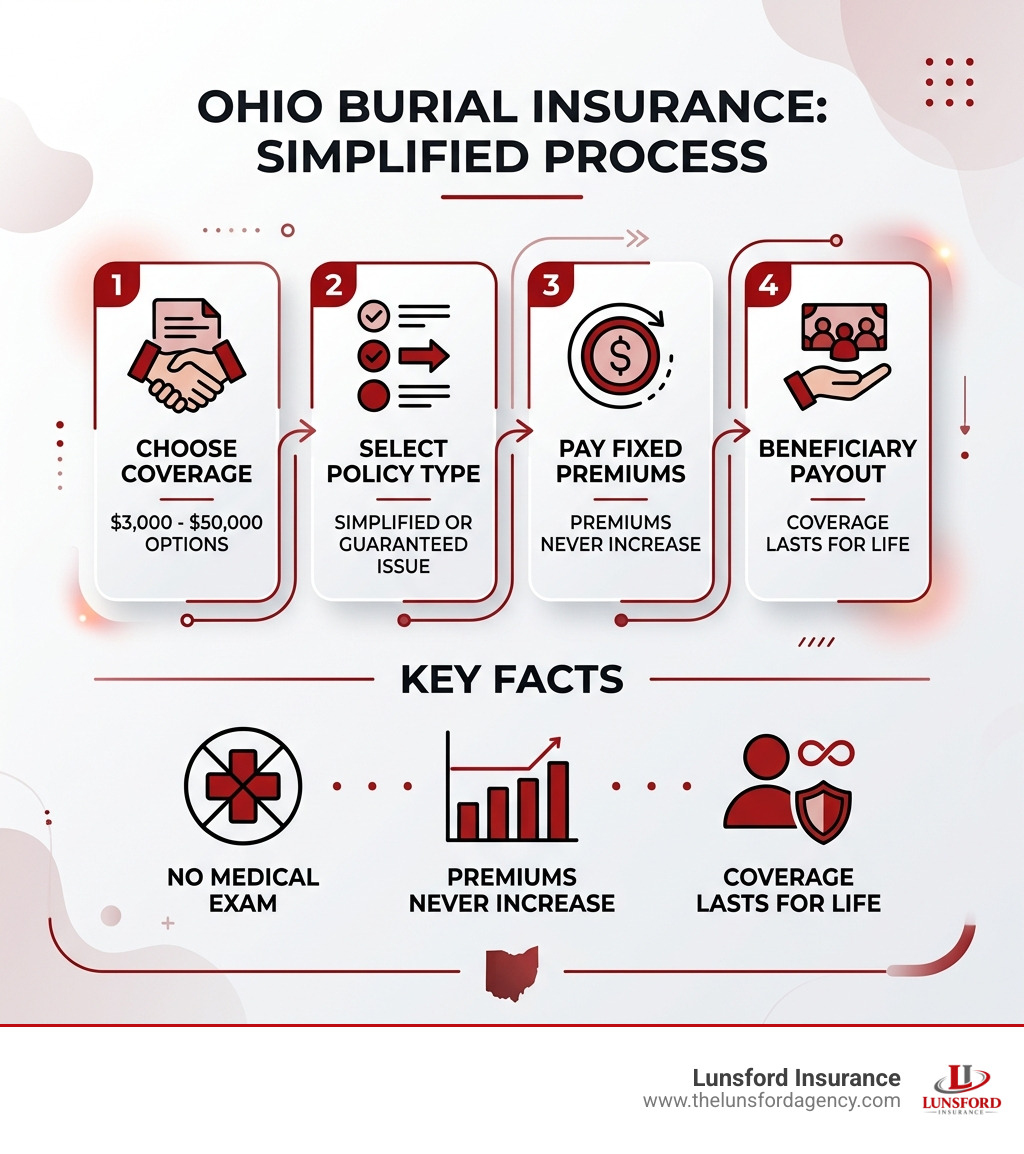
These policies are designed for simplicity. They typically require no medical exam, no health questions, and a simplified approval process. This makes them an ideal solution for those who might have been turned down for traditional life insurance due to heart conditions, diabetes, or other chronic issues.
How Ohio Burial Insurance Complements retirement long term care
Think of burial insurance as the final piece of the puzzle. While your retirement long term care strategy handles the “living” expenses of aging, burial insurance protects your legacy and covers final debts. Because applicants are generally not declined based on health history, it provides a safety net for those who have already seen their health decline.
Understanding the 4-step approval process
We make the process as easy as possible for Ohio seniors. Here is how it typically works:
- Consultation: We discuss your budget and how much coverage you need (usually between $3,000 and $50,000).
- Application: We help you fill out a simple form. There are no “single needle” tests or doctor visits required.
- Simplified Approval: The carrier reviews the application based on their specific rules.
- Policy Issuance: Once approved, your premiums are fixed and will not increase as you age.
Comparing Simplified Issue vs. Guaranteed Issue Policies
It is important to understand the difference between the two main types of final expense policies available in Ohio.
Simplified Issue policies usually involve a few health questions but no exam. If you are relatively healthy, you may qualify for immediate coverage. Guaranteed Issue policies, on the other hand, have no health questions at all. These are for individuals with serious health challenges who cannot qualify elsewhere.
| Feature | Simplified Issue | Guaranteed Issue |
|---|---|---|
| Medical Exam | None | None |
| Health Questions | A few basic questions | None |
| Approval Speed | Very Fast | Near Instant |
| Death Benefit | Typically Immediate | Graded (2-year wait) |
| Best For | Mild/Moderate health issues | Serious/Chronic health issues |
Illustrative comparison only. This information is for educational purposes. Insurance availability, rates, and features vary by carrier and state. Lunsford Insurance is licensed in Ohio and adheres to NAIC regulations.
Policy features and graded benefits
If you choose a Guaranteed Issue policy, it will typically come with a graded death benefit. This means if death occurs due to natural causes within the first two years, the beneficiary receives the premiums paid plus interest (usually 10%). However, if death is accidental, the full benefit is typically covered from day one. This structure allows carriers to offer coverage to everyone, regardless of their medical past.
Disclaimer regarding Ohio regulations
Illustrative comparison only. This information is for educational purposes. Insurance availability, rates, and features vary by carrier and state. Lunsford Insurance is licensed in Ohio and adheres to NAIC regulations. Rates for life insurance typically increase by 8-10% per year for every year you delay starting a policy.
Frequently Asked Questions
What is the average cost of care in Ohio?
While national medians are a good starting point, Ohio costs vary by region. In areas like Chillicothe, home health aide services might range from $25 to $35 per hour. A private room in an Ohio nursing home can exceed $10,000 per month, while assisted living generally falls between $4,500 and $6,000 per month.
Does Medicare pay for long-term custodial care?
No. This is the most common point of confusion. Medicare pays for “skilled” care on a short-term basis (up to 100 days). Help with bathing, dressing, or simple supervision is considered “custodial” and is a personal financial responsibility.
Can I get coverage if I have existing health conditions?
Yes. Through our simplified approval and guaranteed issue options, most Ohioans aged 50-85 can find coverage. We specialize in policies that require no medical exam, meaning your health history is generally not a barrier to getting a burial or final expense policy.
Conclusion
Mastering your retirement long term care plan doesn’t have to be overwhelming. At Lunsford Insurance, we pride ourselves on being a personalized brokerage with strong carrier connections. We focus on finding affordable senior policies that fit your specific needs, whether that’s protecting your assets from nursing home costs or ensuring your final expenses are covered.
Don’t leave your future to chance. By acting now, you can protect your spouse, your children, and the nest egg you’ve worked so hard to build.
Compare Ohio burial insurance options and find coverage that fits your budget.