
Life Insurance for Final Expense 101
Why Life Insurance for Final Expense Matters More Than You Think
Life insurance for final expense is a type of permanent life insurance designed to cover the costs your family will face when you pass away — things like funeral services, burial or cremation, and outstanding bills.
Here’s a quick summary of what you need to know:
| Topic | Key Facts |
|---|---|
| What it is | Small whole life insurance policy for end-of-life costs |
| Coverage amounts | Typically $3,000 to $50,000 |
| Who it’s for | Seniors, retirees, or those with health issues |
| Medical exam required? | Usually no — simplified or guaranteed issue |
| Average funeral cost (Canada) | ~$9,150 / US average ~$7,848 |
| Premiums | Fixed — never increase |
| Payout | Lump sum to your named beneficiary |
The loss of a loved one is already emotionally devastating. The last thing a grieving family should worry about is how to pay for a funeral that can easily cost $7,000 to $9,000 or more.
That financial burden is exactly what final expense life insurance is built to prevent.
Many Ohio seniors assume their savings or existing coverage will be enough. But workplace life insurance often ends at retirement, and Social Security’s death benefit is just $255. Without a dedicated policy, your family may be left scrambling during one of the hardest moments of their lives.
I’m Scott Lunsford, founder of The Lunsford Agency in Chillicothe, Ohio, with over 35 years of experience helping retirees and seniors find the right life insurance for final expense that fits their budget and health situation. In this guide, I’ll walk you through everything you need to make a confident, informed decision.
What is Life Insurance for Final Expense?
When we talk about life insurance for final expense, we are referring to a specific branch of whole life insurance. You might have heard it called “burial insurance” or “funeral insurance.” Regardless of the name, the goal is the same: providing a modest death benefit that is easy to qualify for and guaranteed to stay in place as long as you pay your premiums.
Unlike traditional life insurance policies that might offer millions of dollars in coverage and require you to undergo a rigorous medical exam (including blood draws and physicals), final expense policies are much smaller. They typically range from $2,000 to $50,000. This smaller size makes them significantly more affordable for seniors on a fixed income.
Because it is a form of whole life insurance, it is permanent. It won’t expire after 10 or 20 years like term insurance does. As long as the premiums are paid, the policy remains in force until you pass away. Furthermore, these policies often build a small amount of cash value over time. While you shouldn’t view this as a primary investment vehicle, that cash value can sometimes be accessed via a loan if you face an emergency during your lifetime.
To learn more about how these differ from other types, check out these Final Expense Life Insurance basics.
How Life Insurance for Final Expense Works
The mechanics of life insurance for final expense are refreshingly simple. We believe that at this stage of life, you don’t need more complexity; you need certainty.
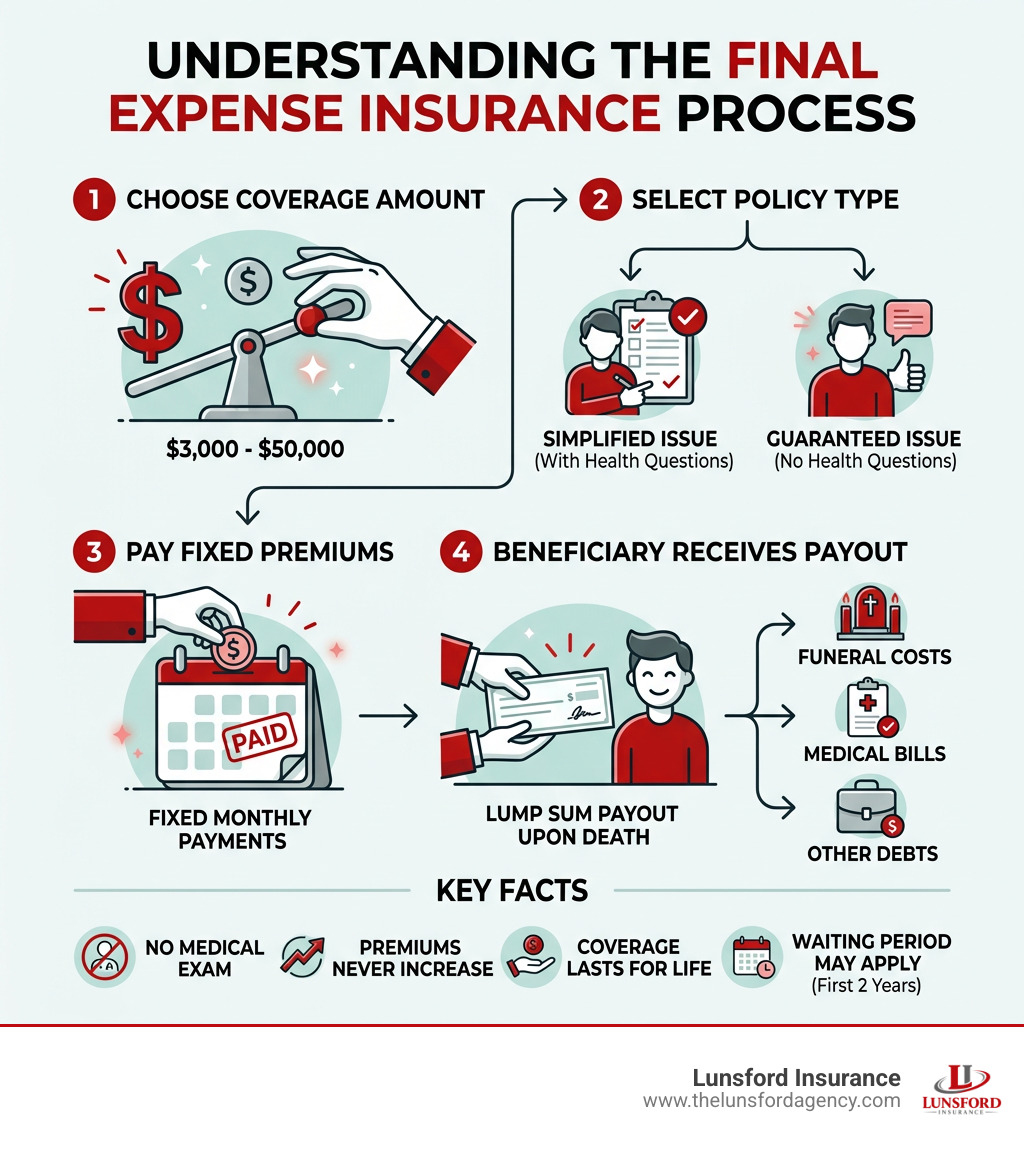
- Choosing Your Beneficiaries: You name the person (or people) who will receive the money. This is often a spouse, a child, or a trusted friend.
- Lump Sum Payout: When you pass away, your beneficiary files a claim. The insurance company then pays out a tax-free lump sum.
- Premium Stability: One of the best features of these policies is that your premiums are locked in. Even if you develop a health condition later or as you get older, your monthly payment will never increase.
- Policy Duration: This is a “set it and forget it” solution. It covers you for your entire life, providing the peace of mind that your family won’t be left with a surprise bill.
If you are looking for local expertise, we provide More info about life insurance in Ohio to help you navigate the specific options available in our state.
Coverage and Benefits of Life Insurance for Final Expense
While the name suggests the money is just for the funeral, the reality is much more flexible. Once the death benefit is paid out, your beneficiary can use the funds for whatever is most pressing.
Common expenses covered include:
- Funeral Arrangements: This includes the casket, cremation services, flowers, and the funeral director’s fees.
- Medical Bills: Often, there are lingering co-pays or hospice costs that haven’t been settled.
- Legal Fees: Dealing with an estate can involve probate costs or attorney fees.
- Outstanding Debt: Credit card balances or small personal loans don’t always disappear when you do.
- Immediate Expenses: Travel costs for family members coming to the service or even utility bills for your home during the transition period.
Understanding these needs is vital for residents in our area. You can read more about 10 reasons why Ohio residents need life insurance to see how these benefits protect your local legacy.

Understanding the Costs of Final Arrangements
It’s an uncomfortable truth: dying is expensive. In the United States, the average cost of a funeral with a viewing and burial is approximately $7,848. If you opt for cremation with a viewing, the average is slightly lower at $6,971, but it still represents a significant financial hit for a family that isn’t prepared.
When you start breaking down the individual costs, it’s easy to see how the bill grows:
- Funeral Director’s Service Fee: ~$1,500 (This is the basic fee for professional services).
- Casket: ~$2,300 (Prices vary wildly depending on material).
- Embalming: ~$500.
- Gravesite: ~$1,000.
- Headstone: ~$1,500.
- Burial Vault: ~$1,000 (Most cemeteries require these to prevent the ground from settling).
Without life insurance for final expense, your family might have to dip into their own savings, take out a high-interest loan, or even resort to crowdfunding to cover these basic necessities.
For a deeper dive into these numbers, see the Average cost of funeral services.
Burial vs. Cremation Cost Comparison (US Averages)
| Service Item | Burial (Average) | Cremation (Average) |
|---|---|---|
| Service Fee | $2,300 | $2,300 |
| Casket/Urn | $2,500 (Casket) | $295 (Urn) |
| Vault/Liner | $1,570 | N/A |
| Preparation of Body | $1,100 | $1,100 |
| Estimated Total | $7,470+ | $3,695+ |
Note: These are estimates and can vary significantly based on your specific choices and location in Ohio.
Factors Affecting Your Premiums
While final expense insurance is generally affordable, several factors will determine your exact monthly rate. At The Lunsford Agency, we help you compare these factors across multiple carriers to find the best fit.
- Age: This is the biggest factor. The younger you are when you start the policy, the lower your monthly premium will be. This is why we encourage folks to look into this in their 50s or 60s rather than waiting until their 80s.
- Gender: Statistically, women tend to live longer than men, which often results in slightly lower premiums for females.
- Smoking Status: If you use tobacco, you will likely pay more. However, even smokers can find competitive rates if they know where to look.
- Coverage Amount: Naturally, a $25,000 policy will cost more than a $5,000 policy.
- Health History: While most of these policies don’t require an exam, your answers to a few health questions can determine if you qualify for “Level” coverage (lowest cost) or “Modified” coverage.
For those living near Columbus, we offer specialized guidance on The best life insurance in Westerville OH to help you find local rates.
Types of Final Expense Policies: Simplified vs. Guaranteed Issue
Not all life insurance for final expense policies are created equal. Depending on your health, you will likely fall into one of two categories.
1. Simplified Issue Life Insurance
This is the “middle ground” of life insurance. There is no medical exam, but you will be asked a series of health questions on the application. These questions usually cover major issues like recent heart attacks, cancer, or strokes.
- Pros: Lower premiums than guaranteed issue; coverage often starts on day one.
- Cons: You can be turned down if your health history is too high-risk.
2. Guaranteed Issue Life Insurance
As the name implies, your acceptance is guaranteed. There are no health questions and no medical exam. If you are within the age range (usually 50 to 85), you cannot be turned down.
- Pros: Perfect for people with serious chronic illnesses or those who have been declined elsewhere.
- Cons: Higher premiums; usually comes with a “graded death benefit” (waiting period).
Is this the right path for you? You can explore further at Final expense insurance: Is it right for you?.
The Graded Death Benefit and Waiting Periods
If you choose a guaranteed issue policy, you need to understand the Graded Death Benefit. Because the insurance company is taking a risk by not asking health questions, they protect themselves with a waiting period—usually the first two years of the policy.
- If you die from natural causes in the first 2 years: Your beneficiary won’t receive the full death benefit. Instead, they typically receive all the premiums you paid into the policy, plus a small amount of interest (often 10%).
- If you die from an accident in the first 2 years: Most policies will pay the full death benefit immediately.
- After 2 years: The full death benefit is payable regardless of how you pass away.
This “two-year rule” is a standard industry practice for no-question policies. It ensures the company can stay solvent while still providing a way for high-risk individuals to get coverage.
Choosing the Right Policy for Your Needs
Selecting a policy isn’t just about finding the lowest price. You want to ensure the company behind the policy is financially stable and has a history of paying claims promptly.
When we work with clients in Dublin or Chillicothe, we look at:
- Carrier Ratings: We only work with companies that have strong financial ratings (like A or A+ from AM Best).
- Benefit Limits: Some companies max out at $25,000, while others go up to $50,000.
- Riders: Some policies include extra benefits, like an accelerated death benefit if you are diagnosed with a terminal illness.
If you are in the Dublin area, we can provide a personalized look at The best life insurance in Dublin OH.
Frequently Asked Questions about Final Expense Insurance
We hear many of the same questions from our Ohio neighbors. Here are the most common ones we answer at The Lunsford Agency.
Do I need a medical exam for final expense insurance?
In almost all cases, no. These policies are designed specifically to avoid the “white coat syndrome” and the long waiting periods of traditional insurance. Whether you choose simplified issue (a few questions) or guaranteed acceptance (no questions), you won’t have to deal with needles or physicals.
Can I use the payout for things other than a funeral?
Absolutely. We always tell our clients that the death benefit is a “gift of cash” to the beneficiary. While we call it life insurance for final expense, the insurance company does not monitor how the money is spent. If your funeral costs $8,000 and your policy is for $15,000, your daughter or son can use the remaining $7,000 to pay off your car, settle your final taxes, or even take a much-needed week off work to grieve.
What happens if I die during the waiting period?
As mentioned in the “Graded Death Benefit” section, if you have a guaranteed issue policy and pass away from natural causes during the first two years, your family will receive a refund of all premiums paid plus interest. While this isn’t the full payout, it ensures that your family doesn’t lose a penny of the money you invested. If the death is accidental, the full benefit is usually paid out even on day one.
Is the payout tax-free?
Yes, under current US tax law, life insurance death benefits are generally paid to beneficiaries free of federal income tax. This is a major advantage over leaving behind a 401(k) or IRA, which may be subject to taxes when the funds are withdrawn.
Can I have more than one policy?
Yes, you can. Some people find that as funeral costs rise due to inflation, they want to add a small “top-up” policy to their existing coverage. We can help you determine if adding a second policy or increasing your current coverage is the more cost-effective move.
Conclusion
Planning for the end of life is one of the most selfless acts you can perform. It’s not about you; it’s about the people you leave behind. By securing life insurance for final expense, you are ensuring that your children or spouse can focus on honoring your memory rather than stressing over a stack of bills.
At Lunsford Insurance, we specialize in these senior-focused, no-exam policies. We aren’t a giant, faceless call center. We are your neighbors in Chillicothe and throughout Ohio. As an independent brokerage, we don’t work for one specific insurance company; we work for you. We have the connections to shop around and find the most affordable rates from the nation’s top carriers.
Whether you are just starting your retirement planning or you’ve realized that your current coverage isn’t enough, we are here to help. Our process is simple, our advice is personalized, and our goal is your total peace of mind.
Don’t leave your family’s financial security to chance. Reach out to us today to Get a quote for life insurance in Ohio and take the first step toward a worry-free future.