

The Best of Both Worlds with LTC Death Benefits
Why Long Term Care Insurance with Death Benefit Is the Smarter Way to Plan
Long term care insurance with death benefit gives you something traditional long-term care policies never could — a guarantee that your money works for your family, no matter what happens.
Here’s the quick answer for anyone comparing their options:
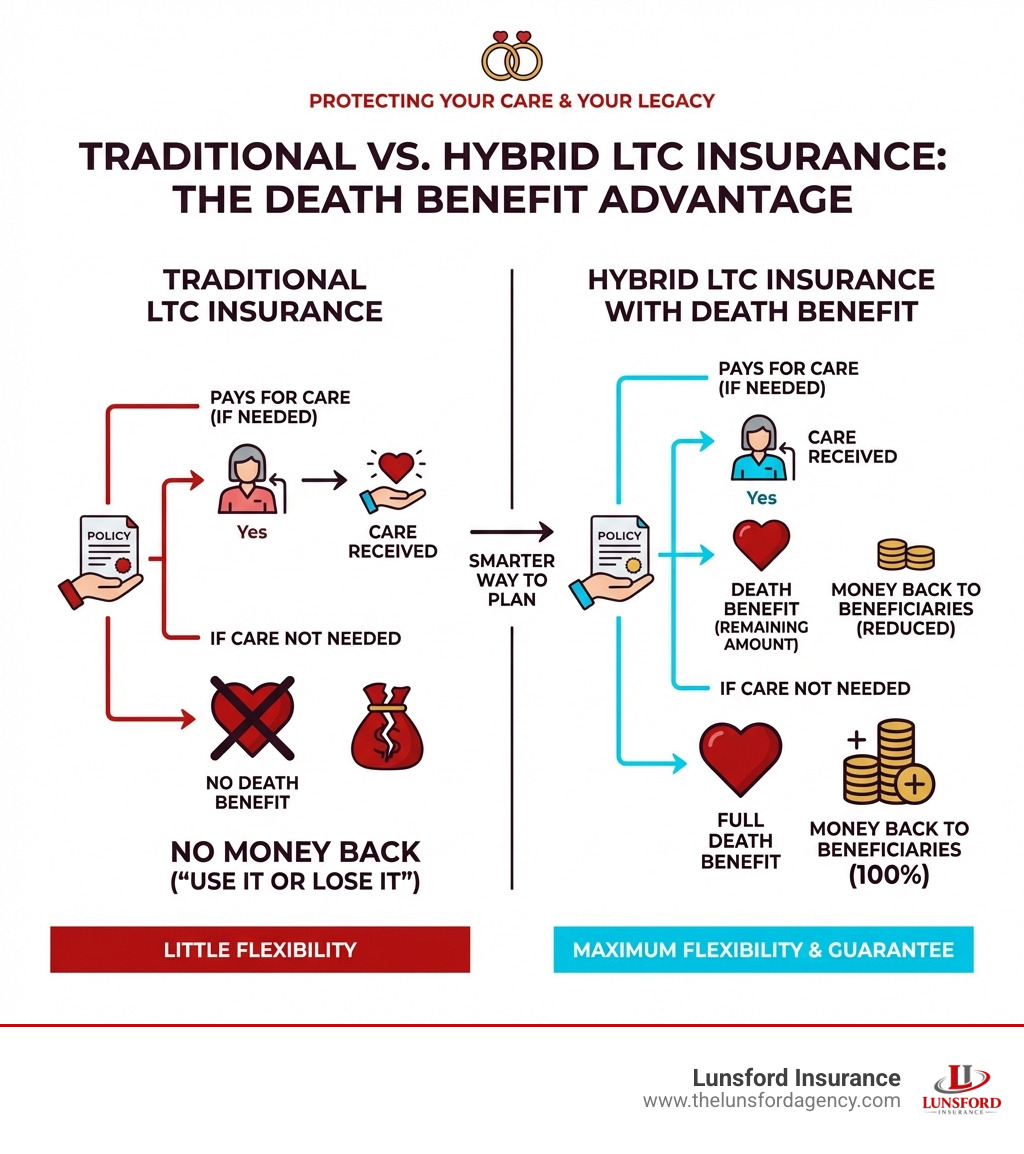
| Policy Type | Pays for Care? | Death Benefit? | Money Back if Unused? |
|---|---|---|---|
| Traditional (standalone) LTC | Yes | No | No (“use it or lose it”) |
| Hybrid LTC + Life Insurance | Yes | Yes (reduces as care is used) | Yes, to beneficiaries |
| LTC Rider on Life Insurance | Yes (accelerates death benefit) | Yes (remaining amount) | Yes, to beneficiaries |
| LTC Annuity | Yes | Yes (remaining account value) | Yes, to beneficiaries |
The core problem with traditional long-term care insurance is simple: only about 25% of people who buy it ever use it. That means most families pay premiums for decades and get nothing back when the policyholder dies.
Hybrid policies solve that. You get long-term care coverage and a death benefit — meaning your money goes to your care, or to your heirs, or both. Nearly 70% of Americans over 65 will need some form of long-term care, and the cost of a private nursing home room now tops $127,000 per year. The financial stakes are real.
I’m Scott Lunsford, founder of The Lunsford Agency in Chillicothe, Ohio, with over 35 years helping Ohio retirees and pre-retirees navigate long term care insurance with death benefit options and build retirement strategies that protect both their health and their legacy. In this guide, I’ll walk you through everything you need to know to make a confident, informed decision.
Understanding Long Term Care Insurance with Death Benefit

When we talk about long term care insurance with death benefit, we are essentially looking at “combination” or “hybrid” products. In the old days, you bought a life insurance policy to protect your family if you died too soon, and you bought a long-term care policy to protect your savings if you lived a long time but needed help.
Today, those two goals have merged. The reality is that 70% of age 65 survivors develop care needs at some point. However, the fear of paying for a policy you might never use—the “use it or lose it” trap—kept many Ohioans on the sidelines. Hybrid policies remove that fear.
A hybrid policy is built on a foundation of life insurance or an annuity. If you need care, you tap into the policy’s value to pay for it. If you don’t need care, your beneficiaries receive a tax-free death benefit. This ensures that the premiums you pay are never “wasted.” According to the Long-Term Services and Supports For Older Americans report, the risks of financing late-life care are significant, making these dual-purpose tools essential for modern long-term care services.
Hybrid Life Insurance with Long Term Care Insurance with Death Benefit
These are often called “linked-benefit” policies. They typically combine a permanent life insurance policy (like Universal Life) with a long-term care rider. One of the biggest draws for our clients in Chillicothe is premium stability. Unlike traditional LTC insurance, where the insurance company might raise your rates down the road, many hybrid policies offer guaranteed fixed premiums.
You can fund these with a single lump sum or spread payments over a few years. Because they build cash value, they offer a level of flexibility that standalone policies can’t match. When asking How Much Care Will You Need?, statistics show the average person needs care for about three years, but one in five will need it for more than five years. A linked-benefit policy can be structured to provide a pool of money that covers these extended stays while still protecting your legacy.
Accelerated Death Benefits (ADBs) and LTC Riders
An Accelerated Death Benefit (ADB) is a feature—often a rider—added to a life insurance policy that allows you to receive a portion of your death benefit while you are still living. To trigger this, a licensed health professional must certify that you have a terminal illness or a chronic condition that prevents you from performing at least two “Activities of Daily Living” (ADLs), such as bathing or dressing.
Typically, an ADB for long-term care might pay out a monthly benefit equal to 2% of the policy’s face value. For example, if you have a $200,000 policy, you could receive $4,000 a month to help cover nursing home costs. It’s important to understand Who Pays for Long-Term Care?, because Medicare specifically does not cover long-term custodial care. These riders bridge that gap by letting you use your own future death benefit to pay for today’s care.
How Payouts and Federal Tax Rules Work
Understanding the “alphabet soup” of tax codes is vital when choosing a long term care insurance with death benefit. The two heavy hitters are IRC Section 7702B and IRC Section 101(g).
- Section 7702B: This applies to traditional “qualified” long-term care contracts. These policies provide tax-free benefits for care but generally do not offer a death benefit.
- Section 101(g): This is the rule that allows hybrid policies and life insurance riders to pay out accelerated death benefits tax-free. Under this section, the IRS treats the money you receive for chronic illness the same way it treats a death benefit—as a tax-free payout.
| Feature | Traditional LTC (7702B) | Hybrid Life/LTC (101(g)) | LTC Annuity |
|---|---|---|---|
| Primary Goal | Maximize care coverage | Care + Inheritance | Asset growth + Care |
| Death Benefit | None (usually) | Guaranteed | Remaining account value |
| Premiums | Can increase | Usually fixed/guaranteed | Lump sum or fixed |
| Tax Status | Benefits tax-free | Benefits & Death Benefit tax-free | Care benefits tax-free |
Tax-Free Treatment of Care and Death Benefits
Thanks to the Health Insurance Portability and Accountability Act (HIPAA) of 1996, the federal government made it easier to afford care by ensuring benefits are tax-free if the policy meets certain criteria. To qualify as “chronically ill” under these rules, you must be unable to perform 2 of the 6 ADLs for at least 90 days or require substantial supervision due to severe cognitive impairment (like Alzheimer’s).
When you receive these payments, they aren’t counted as income. This is a massive advantage. If you withdraw $5,000 from an IRA to pay for a nurse, you might owe $1,000 in taxes. If your hybrid policy pays you $5,000, you keep the whole $5,000. Deciding Long-Term Care Insurance: To Buy or Not to Buy often comes down to this tax efficiency.
Impact of Care Usage on the Final Death Benefit
It is important to remember that in most hybrid policies, the death benefit and the care benefit are linked. Think of it like a bucket of money. If you take a gallon out for home health care, there is one less gallon left for your heirs.
Most policies use a “dollar-for-dollar” reduction. If you have a $250,000 death benefit and you use $100,000 for assisted living, your beneficiaries will receive $150,000 when you pass away. However, some high-quality life insurance products offer a “residual death benefit.” This ensures that even if you spend every cent of the care bucket, your family still receives a small, guaranteed amount (often 5% to 10% of the original face value) to cover funeral expenses.
Costs, Inflation Protection, and Timing Your Purchase
One of the most common questions we get at our Ohio offices is: “How much does long term care insurance with death benefit cost?”
The answer depends on three main factors: your age, your health, and how much coverage you want. Because these policies include a life insurance component, they are generally more expensive than traditional “use it or lose it” policies. However, because the premiums are often fixed, you don’t have to worry about the “sticker shock” of rate hikes at age 80.
For instance, a 60-year-old male might pay around $1,175 a year for a standalone policy with $165,000 in coverage. A hybrid policy might require a larger premium or a single deposit (like $50,000 to $100,000), but it guarantees that someone—either you or your heirs—will get that money back. The Forbes guide on hybrid life insurance notes that these policies are increasingly popular because they provide “exit flexibility.”
Maximizing Your Long Term Care Insurance with Death Benefit
The best time to buy is almost always now. Premiums for any insurance product involving a death benefit increase with age. Furthermore, your health is a “perishable asset.” If you wait until you receive a diagnosis, you may be uninsurable.
At Lunsford Insurance, we specialize in finding affordable, no-exam senior policies. While many hybrid policies require a full medical “underwriting” process, some options allow for simplified issuance. By starting early, you can lock in a lower rate and ensure that inflation doesn’t erode your coverage.
State Regulations and Nonforfeiture Options
In Ohio, we follow strict NAIC (National Association of Insurance Commissioners) guidelines to protect consumers. One critical protection is the nonforfeiture option. If you pay into a policy for years and then decide you can no longer afford the premiums, a nonforfeiture rider ensures you still receive a reduced “paid-up” benefit based on what you’ve already paid, rather than losing everything.
Another vital protection is the reinstatement right. If a policyholder misses a payment because they have developed a cognitive impairment (like dementia), many states, including Ohio, allow the policy to be reinstated within five months if proof of the impairment is provided. This is a literal lifesaver for families dealing with a sudden health crisis. You can read more about essential coverage types for long-term care in Ohio to see how these rules apply locally.
Avoiding Common Pitfalls and Maximizing Value
Buying long term care insurance with death benefit is a big step, and there are a few “potholes” you’ll want to avoid:
- Assuming you’ll never need it: 29% of adults over 59 admit they told their younger selves they’d never need care—only to be surprised later.
- Missing the Inflation Rider: A $200-a-day benefit sounds great today, but in 20 years, it might only cover half a day of care. Always look for 3% or 5% compound inflation protection.
- Lapsing the Policy: If you miss payments, you lose the death benefit and the care coverage. Set up automatic drafts from your bank account.
- Not Checking for “Indemnity” vs. “Reimbursement”: Reimbursement policies require you to submit receipts and wait for a check. Indemnity policies pay you a flat monthly amount once you qualify, giving you the freedom to pay a family member or a neighbor to help you at home.
Choosing the Right Policy for Your Goals
Your choice depends on your “Why.”
- If your goal is to leave a large inheritance: Focus on a life insurance policy with a smaller LTC rider.
- If your goal is to protect your spouse from nursing home costs: A linked-benefit hybrid with a large care pool is usually best.
- If you have “lazy money” in a CD or savings: An annuity-linked LTC policy can turn that taxable interest into tax-free care.
Real-World Scenarios: Care Needed vs. Not Needed
Let’s look at how this plays out for a typical Ohio family. Imagine “Sarah,” age 60, who puts $100,000 into a hybrid policy. This creates a $150,000 death benefit and a $450,000 pool for long-term care.
- Scenario A (Care Needed): Sarah suffers a stroke at 75 and needs four years of assisted living. The policy pays out $300,000 for her care. When she passes away, her children still receive a $50,000 death benefit (the original $150k minus a portion of the used care, depending on the policy’s specific “residual” rules).
- Scenario B (No Care Needed): Sarah lives to be 95 and passes away peacefully in her sleep. She never spent a dime on care. Her children receive the full $150,000 death benefit, tax-free.
In both cases, Sarah’s $100,000 investment provided value. Compare that to supplemental retirement plans or traditional insurance where that money might have simply disappeared if unused.
Frequently Asked Questions about LTC Death Benefits
Are death benefits from hybrid LTC policies taxable to my heirs?
Generally, no. Under IRC Section 101, death benefits from life insurance are received by beneficiaries tax-free. This is one of the most powerful wealth-transfer tools available.
Can I add an LTC rider to my existing life insurance policy?
Sometimes. Some carriers allow you to add a rider to an existing permanent policy, but it usually requires new medical underwriting. In many cases, it is more cost-effective to start a new hybrid policy or exchange your old policy for a new one using a “1035 Exchange” to avoid taxes.
What happens to the death benefit if I use all my LTC coverage?
In most basic riders, the death benefit is reduced dollar-for-dollar. If you spend the entire death benefit on care, the payout to heirs becomes zero. However, many hybrid policies include an “Extension of Benefits” that provides extra care money after the death benefit is gone, and some offer a small “residual death benefit” so your family still gets $10,000 to $20,000 for final expenses.
Conclusion
Planning for the future doesn’t have to be a “win-lose” proposition. With long term care insurance with death benefit, you can protect your savings from the rising costs of nursing homes while ensuring your family’s legacy remains intact.
At Lunsford Insurance, we take pride in being a personalized brokerage. We aren’t beholden to just one company; we have strong connections across the industry to find the most affordable, no-exam policies for our neighbors in Chillicothe and throughout Ohio. Whether you are looking for life insurance, annuities, or a comprehensive retirement plan, we are here to help you navigate the complexities of senior insurance.
Ready to see how a hybrid policy fits into your plan? Secure your legacy with Long-Term Care Insurance in Ohio and let us help you find the peace of mind you deserve.