

The Buckeye Guide to Supplemental Health Insurance
Why Supplemental Health Insurance in Ohio Matters for Your Retirement Budget
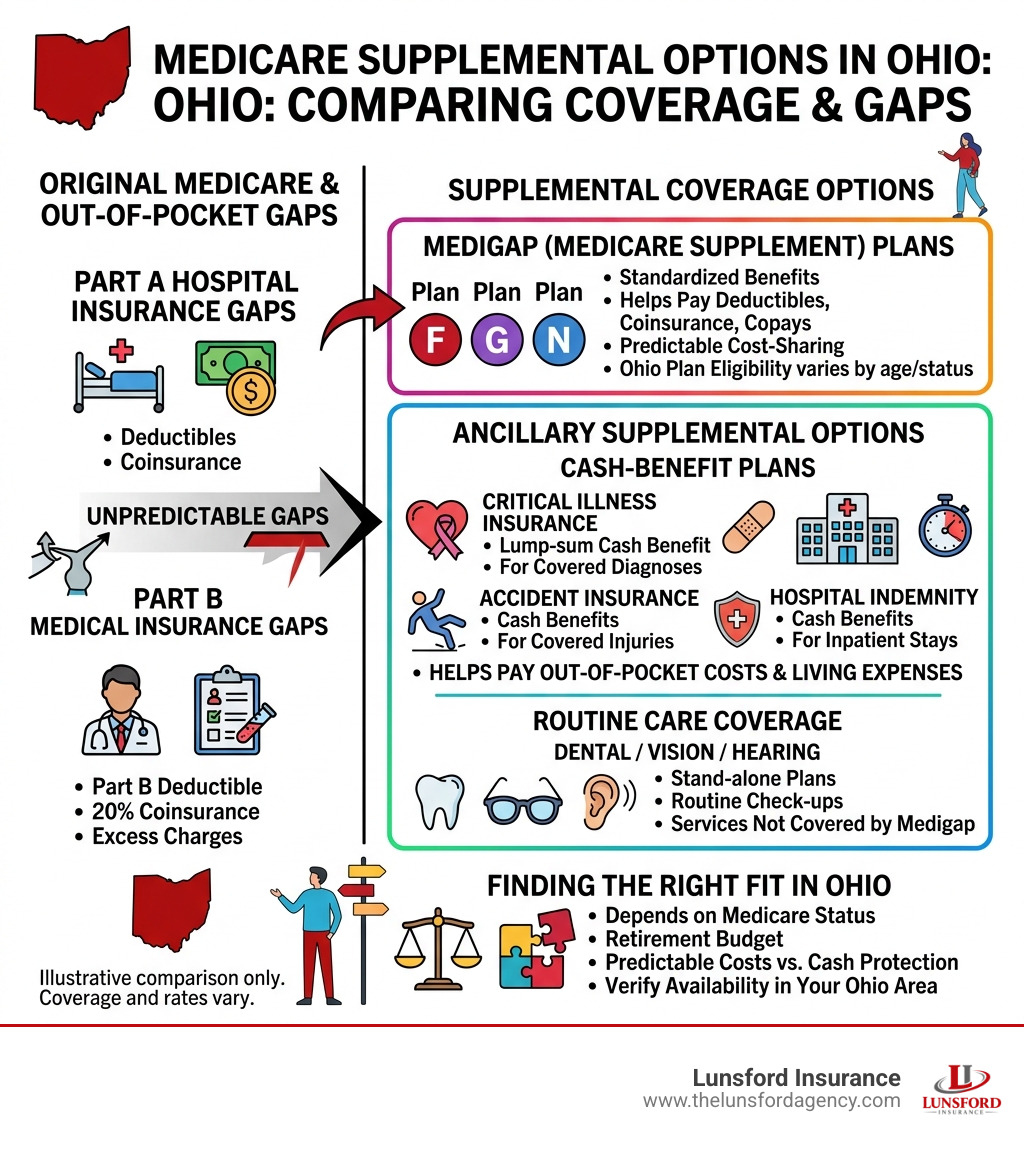
Supplemental health insurance Ohio residents rely on most often is Medicare Supplement insurance, also called Medigap. These are private plans that help pay out-of-pocket costs that Original Medicare does not cover — things like deductibles, coinsurance, and copays.
Here is a quick overview of your main options:
| Coverage Type | What It Does | Who It’s For |
|---|---|---|
| Medigap (Medicare Supplement) | Helps pay Medicare cost-sharing gaps | Anyone with Original Medicare Parts A & B |
| Plan G | Covers most Medicare-approved costs after the Part B deductible | Those eligible for Medicare on or after Jan 1, 2020 |
| Plan N | Lower premiums; some office visit and ER copays apply | Those who want lower monthly costs |
| Plan F | Broadest coverage; covers Part B deductible | Only those eligible for Medicare before Jan 1, 2020 |
| Critical Illness Insurance | Lump-sum cash benefit after a covered diagnosis | Those wanting extra cash-benefit protection |
| Accident Insurance | Cash benefits for covered injuries | Those wanting help with injury-related costs |
| Hospital Indemnity | Cash benefits for inpatient hospital stays | Those wanting income protection during hospitalization |
| Dental / Vision / Hearing | Stand-alone routine care coverage | Anyone needing coverage Medigap does not include |
illustrative comparison only. Coverage amounts, rates, and availability vary by carrier, age, and location.
Original Medicare provides a solid foundation, but it was never designed to cover everything. Out-of-pocket costs can add up quickly — and for retirees on a fixed income, that uncertainty is a real problem. Medigap plans are standardized by letter, meaning the same plan letter offers the same core benefits no matter which carrier you buy it from. That makes them easier to compare than most insurance products. Beyond Medigap, Ohio residents can also choose cash-benefit options like critical illness, accident, and hospital indemnity coverage, or stand-alone dental, vision, and hearing plans. The best option depends on your Medicare status, budget, and whether you want predictable cost-sharing or cash-benefit protection.
I’m Scott Lunsford, an independent insurance professional based in Chillicothe, Ohio, and I have been helping clients navigate supplemental health insurance options since 1988. In this guide, I’ll walk you through every major plan type so you can make a confident, informed decision.
Disclaimer: This article is for informational purposes only. Plan availability, premiums, and benefits vary by carrier and location. Always verify current plan details with a licensed professional or visit Medicare.gov.
Supplemental health insurance word roundup:
Understanding Medicare Supplement Insurance in Ohio (Medigap)
When we talk about supplemental health insurance in Ohio, the conversation usually starts with Medigap. These policies are sold by private insurance companies but are strictly regulated. The primary goal of a Medigap policy is to bridge the financial “gaps” left behind by Original Medicare (Part A and Part B).
As we navigate our retirement years in the Buckeye State, we quickly learn that Original Medicare leaves out-of-pocket costs such as deductibles, coinsurance, and copays. For example, if you have a hospital stay, Part A has a deductible you must pay before Medicare kicks in. If you visit a specialist, Part B typically covers 80% of the Medicare-approved amount, leaving you responsible for the remaining 20%. Medigap plans are designed to step in and pay those costs so you aren’t hit with a surprise bill.
You can find more detailed information on the Ohio Department of Insurance Medicare page or explore our specific Medicare services to see how these plans fit into a broader retirement strategy.

Standardized Benefits for Ohio Residents
One of the most consumer-friendly aspects of Medigap is standardization. In Ohio, Medigap plans are standardized by letter (such as Plan A, G, or N). This means the same plan letter offers the same core benefits across carriers. If you choose a Plan G from Company X, it will provide the exact same medical coverage as a Plan G from Company Y.
Because of this carrier consistency, the primary differences you’ll find when shopping for supplemental health insurance in Ohio are the premium price, the company’s reputation for customer service, and any “extra” perks they might throw in, like a fitness membership. For more on the legal framework of these plans, the Ohio Department of Insurance Medigap guide is an excellent resource.
Provider Access and Flexibility
A major reason many of our neighbors in Chillicothe and across Ohio choose Medigap over other options is freedom. Unlike some managed care plans that require you to stay within a specific network of doctors, Medigap generally lets you see any provider that accepts Medicare.
This nationwide portability is perfect for “snowbirds” who head south for the winter or for anyone who wants the peace of mind knowing they can visit top-tier specialists anywhere in the country without needing a referral. As long as the provider accepts Original Medicare, your Medigap plan will follow you.
Popular Medigap Plan Options for Supplemental Health Insurance in Ohio
Choosing the right letter plan is about balancing your monthly premium budget with your desire for predictable medical costs. While there are ten different letter plans available, most Ohioans focus on a few key options.
| Feature | Plan G | Plan N | Plan F* |
|---|---|---|---|
| Part A Deductible | Covered | Covered | Covered |
| Part B Coinsurance | Covered | Covered (except small copays) | Covered |
| Part B Deductible | Not Covered | Not Covered | Covered |
| Foreign Travel Emergency | 80% | 80% | 80% |
| Monthly Premium | Mid-range | Lower | Higher |
illustrative comparison only. Plan F is only available to those eligible for Medicare before January 1, 2020.
For a deeper dive into these options, visit our Medicare services page.
Coverage Details for Plan G and Plan N
Plan G has become the “gold standard” for new Medicare enrollees. Plan G covers most Medicare-approved costs after the Part B deductible is met. In 2026, once you pay that relatively small annual deductible, Plan G typically pays 100% of your remaining Medicare-covered medical bills for the rest of the year.
Plan N is a fantastic choice for those who are budget-conscious but still want robust protection. Plan N has lower premiums but includes some copays. Specifically, you may pay a $20 office visit copay and a $50 emergency room copay (if you aren’t admitted as an inpatient). For many healthy seniors, the monthly premium savings on Plan N more than make up for the occasional copay.
Eligibility for Plan F and High-Deductible Plans
You might hear older friends talking about Plan F, which covers everything, including the Part B deductible. However, Plan F is only available for those eligible for Medicare before January 1, 2020. If you turned 65 or became eligible due to disability after that date, Plan F is off the table.
For those who want to protect against catastrophic costs but keep their monthly overhead very low, high-deductible options exist. A High-Deductible Plan G requires you to pay a plan deductible ($2,950 in 2026) before the plan begins to pay benefits. Similarly, Plan K and Plan L have out-of-pocket limits ($8,000 and $4,000 respectively in 2026). Once you hit those limits, the plan pays 100% of covered services for the rest of the calendar year.

Enrollment and Eligibility for Supplemental Health Insurance in Ohio
Timing is everything when it comes to supplemental health insurance in Ohio. If you miss your window, you might find it harder or more expensive to get the coverage you want.
The Medigap Open Enrollment Period
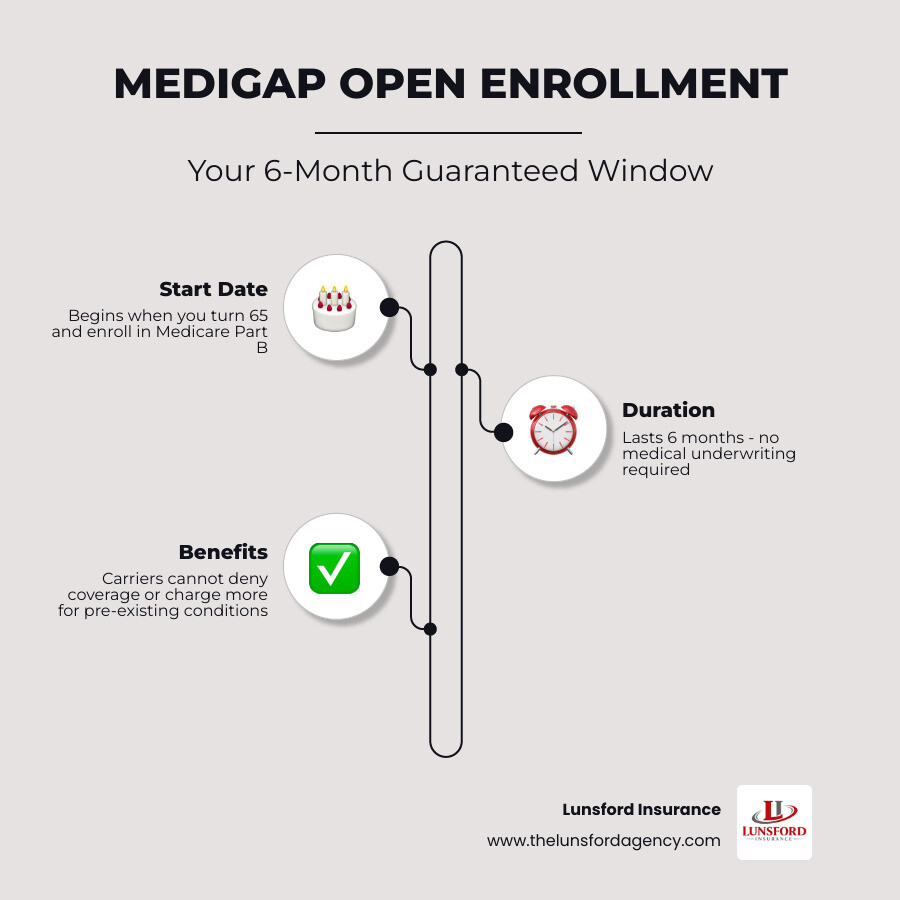
The best time to buy a Medigap policy is during your Medigap Open Enrollment Period. This is a six-month guaranteed-issue window that starts when you are age 65 or older and enrolled in Medicare Part B.
During this six-month window, carriers generally cannot deny coverage or charge more for pre-existing conditions. This is a “no-questions-asked” period where your health history doesn’t matter. If you wait until years later to apply, you may have to go through medical underwriting, where a company can look at your health history and potentially deny your application or charge a much higher premium.
Steps to Secure Supplemental Health Insurance in Ohio
Securing your coverage doesn’t have to be complicated. We recommend following this simple 4-step process:
- Choose Coverage: Decide which letter plan (like G or N) fits your medical needs.
- Select Policy: Compare premiums from different Ohio carriers for that specific letter plan.
- Pay Fixed Premiums: Set up your monthly payments (many carriers offer a discount for automatic bank drafts).
- Beneficiary Payout: Once active, your plan pays the doctors and hospitals directly after Medicare pays its share.
If you need help navigating these steps, you can learn more about our services and how we assist Ohio residents in making these choices.
Ancillary Cash-Benefit and Stand-Alone Coverage Options
While Medigap handles the “gaps” in Medicare, it doesn’t cover everything. There are other types of supplemental health insurance in Ohio residents use to protect their savings. These are ancillary products that provide cash-benefit or stand-alone coverage. It is important to remember that these are not replacements for Medigap, but rather complements to a total health strategy.
Critical Illness and Accident Insurance
Critical illness insurance provides a lump-sum cash benefit upon diagnosis of a covered condition like a heart attack, stroke, or invasive cancer. Because a major diagnosis often comes with non-medical costs—like travel to specialized hospitals or lost income for a spouse acting as a caregiver—this cash can be a lifesaver.
Accident insurance provides cash benefits for injuries resulting from a covered accident. Whether it’s a fall on an icy Ohio sidewalk or a kitchen mishap, these plans pay a set amount for things like ER visits, X-rays, or physical therapy, helping you manage out-of-pocket expenses that your primary insurance might not cover.
Hospital Indemnity and Routine Care
Hospital indemnity insurance provides cash benefits for hospital stays. These plans typically pay a fixed daily amount for every day you are confined to a hospital. This cash is paid directly to you, and you can use it for anything—from paying your Medicare deductible to covering your utility bills while you recover.
Finally, we often help clients with Dental, Vision, and Hearing (DVH) plans. Since Original Medicare and Medigap generally do not cover routine dental cleanings, eye exams, or hearing aids, these stand-alone routine coverage options are essential for maintaining your overall health as you age.

Frequently Asked Questions about Ohio Supplemental Insurance
What is the difference between Medigap and Medicare Advantage?
This is the most common question we get. Medigap works with Original Medicare to pay for out-of-pocket costs, acting as a secondary payer. You keep your red, white, and blue Medicare card. Medicare Advantage (Part C), on the other hand, is an alternative way to get Medicare benefits through private networks (like HMOs or PPOs). With Advantage, the private company takes over your care management. You cannot have both a Medigap plan and a Medicare Advantage plan at the same time.
Does supplemental insurance cover prescription drugs?
Modern Medigap plans sold today do not cover retail prescription drugs. To get drug coverage, Ohioans typically need to enroll in a stand-alone Medicare Part D plan. It is usually best to sign up for Part D when you first become eligible to avoid a late-enrollment penalty later on.
Can I switch my Medigap plan at any time?
In Ohio, you can apply to switch plans at any time of the year. However, there is a catch: if you are outside of your initial six-month guaranteed-issue window, insurance companies will likely use medical underwriting. They will ask health questions and look at your medical records to determine your eligibility and pricing. If you have serious health issues, you might not be able to switch carriers.
Conclusion
Navigating supplemental health insurance ohio can feel like trying to drive through a Columbus construction zone—confusing and full of detours. But it doesn’t have to be. At Lunsford Insurance, we pride ourselves on providing personalized brokerage and expert guidance. With our strong carrier connections, we help you find the most competitive rates for the standardized plans you need.
The best option depends on your Medicare status, budget, and whether you want predictable cost-sharing or cash-benefit protection. Whether you are in Chillicothe or anywhere else in the great state of Ohio, we are here to help you bridge the gaps.
Ready to take the next step in your retirement planning? Secure your future with Supplemental Retirement Plans in Ohio and ensure your healthcare costs never stand in the way of your peace of mind.