

The Ultimate Guide to Long-Term Care Insurance Maximums
Why Your Long-Term Care Insurance Maximum Lifetime Benefit Could Be the Most Important Number in Your Retirement Plan
The long term care insurance maximum lifetime benefit is the total dollar amount your policy will pay out over your lifetime for covered care — and choosing the right number could mean the difference between financial security and a depleted retirement account.
Here’s a quick breakdown of what you need to know:
| Benefit Type | How It Works | Typical Payout Cap |
|---|---|---|
| Dollar-amount pool | Set total benefit (e.g., $165,000–$300,000) drawn down as care is used | Fixed at purchase, may grow with inflation rider |
| Time-limited benefit | Pays for a set period (commonly 2–5 years) | Daily benefit × number of covered days |
| Unlimited/lifetime benefit | Pays as long as care is needed, no cap | No maximum — rarest and most expensive option |
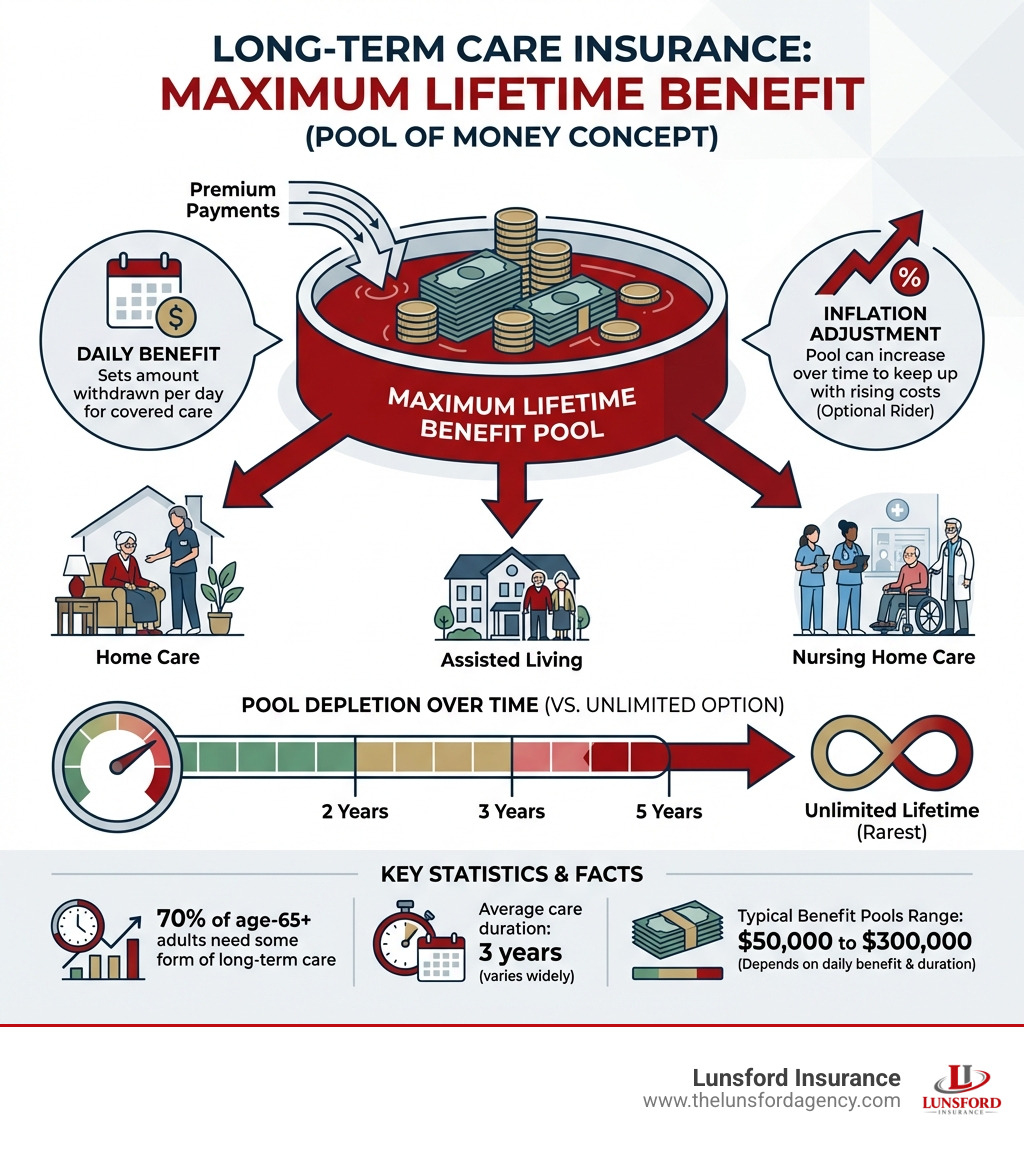
Most policies today use a pool of money — a set total benefit you draw from over time. That pool is calculated simply: your daily benefit amount multiplied by the number of covered days. For example, a $150/day benefit over three years equals roughly $164,250 in total coverage.
The hard reality? About 70% of people who reach age 65 will need some form of long-term care, and costs are rising fast. A semi-private nursing home room already runs about $115,000 per year nationally. Choosing too low a maximum — or skipping coverage altogether — can leave you, or your family, exposed to costs that can easily exceed $150,000 or more.
I’m Scott Lunsford, founder of The Lunsford Agency, and with over 35 years of experience in insurance and financial services, I’ve helped many Ohio families navigate the complexities of the long term care insurance maximum lifetime benefit to find coverage that fits both their needs and their budget. In the sections below, we’ll break down every aspect of LTC maximums so you can make a confident, informed decision.
Understanding the Long Term Care Insurance Maximum Lifetime Benefit
When you sit down to plan for your future in Ohio, whether you are in Chillicothe or Columbus, the term “maximum lifetime benefit” will come up frequently. Think of this as your personal “care bucket.” Every time you receive a covered service—be it help with bathing at home or a stay in a skilled nursing facility—you take a scoop out of that bucket. Once the bucket is empty, the insurance company stops paying.
In the modern insurance landscape, most carriers no longer offer “unlimited” buckets. Instead, they provide a structured pool of money. This structure is designed to give you flexibility. If your policy has a $200,000 maximum, you can use it quickly for high-cost nursing home care, or stretch it out over many years for part-time home health care.
The Modern Care Landscape
It is important to understand where care actually happens today. While many people fear the nursing home, the reality is that the majority of claims now start with home care or assisted living. According to industry data, the average carrier claim amounts since inception are approximately $37,000 for home care, $42,000 for nursing home care, and $68,000 for assisted living. However, about 15% of claims remain open for much longer, which is where the long term care insurance maximum lifetime benefit becomes critical.
To get a sense of what care might cost you locally, you can use tools like the Mutual of Omaha cost calculator. In 2021, the national average for home health care was roughly $226.40 per day—and those numbers only go up with time.

| Coverage Duration | Sample Daily Benefit | Estimated Maximum Lifetime Benefit |
|---|---|---|
| 3 Years | $150 | $164,250 |
| 5 Years | $150 | $273,750 |
| Lifetime (Unlimited) | $150 | Unlimited (No Cap) |
How to Calculate Your Long Term Care Insurance Maximum Lifetime Benefit
Calculating your total coverage isn’t just about picking a number out of a hat. We use a specific formula to help our clients understand their protection levels.
- Select a Daily (or Monthly) Benefit: This is the maximum the policy will pay for a single day of care.
- Select a Benefit Period: This is usually expressed in years (e.g., 3 years, 5 years).
- The Multiplier: You multiply the Daily Benefit × 365 Days × Benefit Period.
Service Days vs. Calendar Days
One nuance often overlooked is how you satisfy your “elimination period” (the waiting period before benefits kick in). Some policies use service days, meaning the clock only ticks on days you actually receive professional care. Others use calendar days, which is much more consumer-friendly because the clock ticks every day regardless of whether you had a nurse visit. This distinction can affect how quickly you start tapping into your long term care insurance maximum lifetime benefit.
The Inflation Factor
If you buy a policy at age 55 with a $200,000 maximum, that amount won’t buy much care when you’re 85. That’s why inflation adjustments are vital. A 3% compound inflation rider ensures your “bucket” grows every year, keeping pace with the rising costs of Ohio healthcare.
Factors Influencing Your Long Term Care Insurance Maximum Lifetime Benefit
Choosing your maximum is a balancing act between risk and budget. Several key factors come into play:
- Age and Health: The younger and healthier you are when you apply, the more affordable the higher maximums will be. At Lunsford Insurance, we specialize in affordable, no-exam senior policies, which can be a game-changer for those who want coverage without the hassle of a medical checkup.
- Income and Assets: A common rule of thumb is the 2% income rule—aim to spend no more than 2% of your household income on LTC premiums. If you have significant assets to protect, a higher maximum lifetime benefit is often justified.
- The Odds of Needing Care: Research shows that about 69% of people turning 65 will need care. On average, women need care for 3.7 years, while men need it for 2.2 years. These statistics suggest that a 3-to-5-year benefit period covers the vast majority of cases.
Limited vs. Unlimited: Comparing Coverage Durations
The debate between limited and unlimited coverage is essentially a debate about “tail risk.” Tail risk refers to those rare but devastating cases—like advanced Alzheimer’s—where care is needed for a decade or more.
The 3-5 Year Standard
Most policies sold today are capped at 3 to 5 years. Why? Because it strikes the best balance for most families. Statistics from a RAND study on nursing home use indicate that while many nursing home stays are short, 10% of residents will stay for an average of 3 years, and 5% will stay for over 4 years. For that “5% tail,” out-of-pocket costs can easily exceed $150,000.
Common benefit period options include:
- 2 Years: Budget-friendly, covers short-term recovery needs.
- 3 Years: The “sweet spot” for many, covering the statistical average.
- 5 Years: Robust protection that covers most catastrophic scenarios.
- Lifetime: True “peace of mind” coverage, though increasingly rare and expensive.
The Cost Impact of a Lifetime Maximum Benefit
If you are considering an unlimited long term care insurance maximum lifetime benefit, you need to be prepared for the premium “bump.”
Standalone Policies
For a traditional, standalone LTC policy, moving from a limited pool to an unlimited lifetime benefit can result in a premium increase of 51% or more. For many, this price jump makes the policy unaffordable, leading to a higher risk of the policy lapsing later in life.
Hybrid Plans
This is where hybrid plans (life insurance or annuities with LTC riders) shine. Because these plans already have a death benefit component, the “bump” to add a lifetime LTC benefit is often much smaller—frequently around 11%. For affluent buyers or those with a specific concern about long-duration care, the hybrid route is often the most cost-effective way to secure unlimited protection.
Key Features That Expand Your Benefit Pool
Your long term care insurance maximum lifetime benefit isn’t always a static number. Several policy features can effectively “grow” your pool or make it more efficient.
Inflation Protection: The Secret Sauce
We cannot stress this enough: without inflation protection, your policy may be worthless by the time you need it.
- 3% Compound: A standard choice that helps the benefit pool grow steadily.
- 5% Compound: The “gold standard” recommended for younger buyers (under age 65). Over 24 years, a 3% inflation rate can effectively halve the purchasing power of a fixed benefit.
Shared Care Riders
For couples in Ohio, a shared care rider is one of the smartest moves you can make. It allows spouses to share a single pool of benefits. If one spouse exhausts their individual bucket, they can dip into their partner’s bucket. This effectively doubles the available long term care insurance maximum lifetime benefit for whichever spouse needs it most, without requiring each person to buy a massive (and expensive) individual policy.
Restoration of Benefits
Some policies include a “restoration” feature. If you use part of your benefit pool, recover fully, and go a set period (usually six months) without needing care, the policy “refills” your maximum benefit to its original level. This is incredibly valuable for people who might have a stroke or surgery, recover, and then need care again years later for a different issue. You can find more details on these features in our Long Term Care Category blog.
Financial and Tax Considerations for Maximum Benefits
The way your benefits are paid out can have significant tax implications. Most modern policies are “Tax-Qualified,” meaning they meet federal HIPAA standards.
- Tax-Free Benefits: Generally, benefits paid from a qualified LTC policy are not counted as taxable income.
- Per-Diem Limits: For 2025, the IRS allows per-diem (daily) benefits to be tax-free up to $420 per day. If your policy pays more than this and your actual expenses are lower, the excess might be taxable.
- Premium Deductibility: In many cases, a portion of your LTC premiums can be deducted as a medical expense if they exceed 7.5% of your Adjusted Gross Income (AGI). The amount you can deduct is based on your age.
Understanding these statistics on LTC duration and costs is essential for tax planning. For self-employed individuals in Ohio, the tax advantages can be even more pronounced, as they may be able to deduct the entire age-based premium amount.
Frequently Asked Questions about LTC Maximums
What happens if I exhaust my maximum lifetime benefit?
Once your long term care insurance maximum lifetime benefit is reached, the insurance company is no longer obligated to pay for your care. At that point, you would need to rely on personal savings, family support, or—if your assets have been depleted—Medicaid. This is why choosing a realistic maximum and including inflation protection is so vital for asset protection.
Can I increase my maximum benefit after the policy is issued?
Generally, no. Most insurance companies require you to go through new medical underwriting if you want to increase your coverage later. However, some policies offer a “Future Purchase Option” (FPO) that allows you to buy additional coverage at set intervals without a medical exam. Because we offer no-exam options, we can often help clients find creative ways to layer coverage if their needs change.
How does a shared benefit pool work for married couples?
A shared pool (often called a “Shared Care Rider”) links two policies together. If Spouse A has a 3-year pool and Spouse B has a 3-year pool, they effectively have a 6-year pool to share. If Spouse A uses 4 years of care, they take 3 from their own pool and 1 from Spouse B’s. This provides a safety net for the spouse who might face a “tail risk” event like dementia.
Conclusion: Planning Your Protection with Lunsford Insurance
Navigating the long term care insurance maximum lifetime benefit doesn’t have to be overwhelming. At Lunsford Insurance, we believe that the best policy is the one that provides meaningful protection without straining your monthly budget.
Whether you are looking for a standalone policy with a 3-year cap or a hybrid plan with an unlimited lifetime benefit, we are here to help. As an independent brokerage, we have strong connections with top carriers, allowing us to find the most competitive rates for Ohio seniors. We pride ourselves on offering a personalized, “no-exam” approach that makes securing your future simpler and more affordable.
If you are ready to protect your assets and ensure you have the care you deserve, let’s talk. We specialize in Long Term Care Insurance Ohio and comprehensive retirement planning. Contact us today to see how we can build a “care bucket” that’s just the right size for you.