

Annuity Options in Ohio That Won’t Break the Bank
Why Retirement Income Protection Matters for Ohio Seniors
Retirement income protection means making sure you have enough guaranteed income to cover your needs for the rest of your life — no matter how long you live, what the market does, or how much healthcare costs rise.
Here is a quick look at the key ways to protect your retirement income:
| Strategy | What It Does |
|---|---|
| Annuities | Convert savings into guaranteed lifetime income |
| Social Security optimization | Delay to age 70 for up to 32% more per month |
| Sustainable withdrawals | Limit to 4%-5% per year to avoid depleting savings |
| Long-term care insurance | Shields savings from nursing home and home care costs |
| HSAs | Triple tax advantage for medical expenses |
| Inflation hedges | TIPS, stocks, or COLA riders protect purchasing power |
(illustrative comparison only)
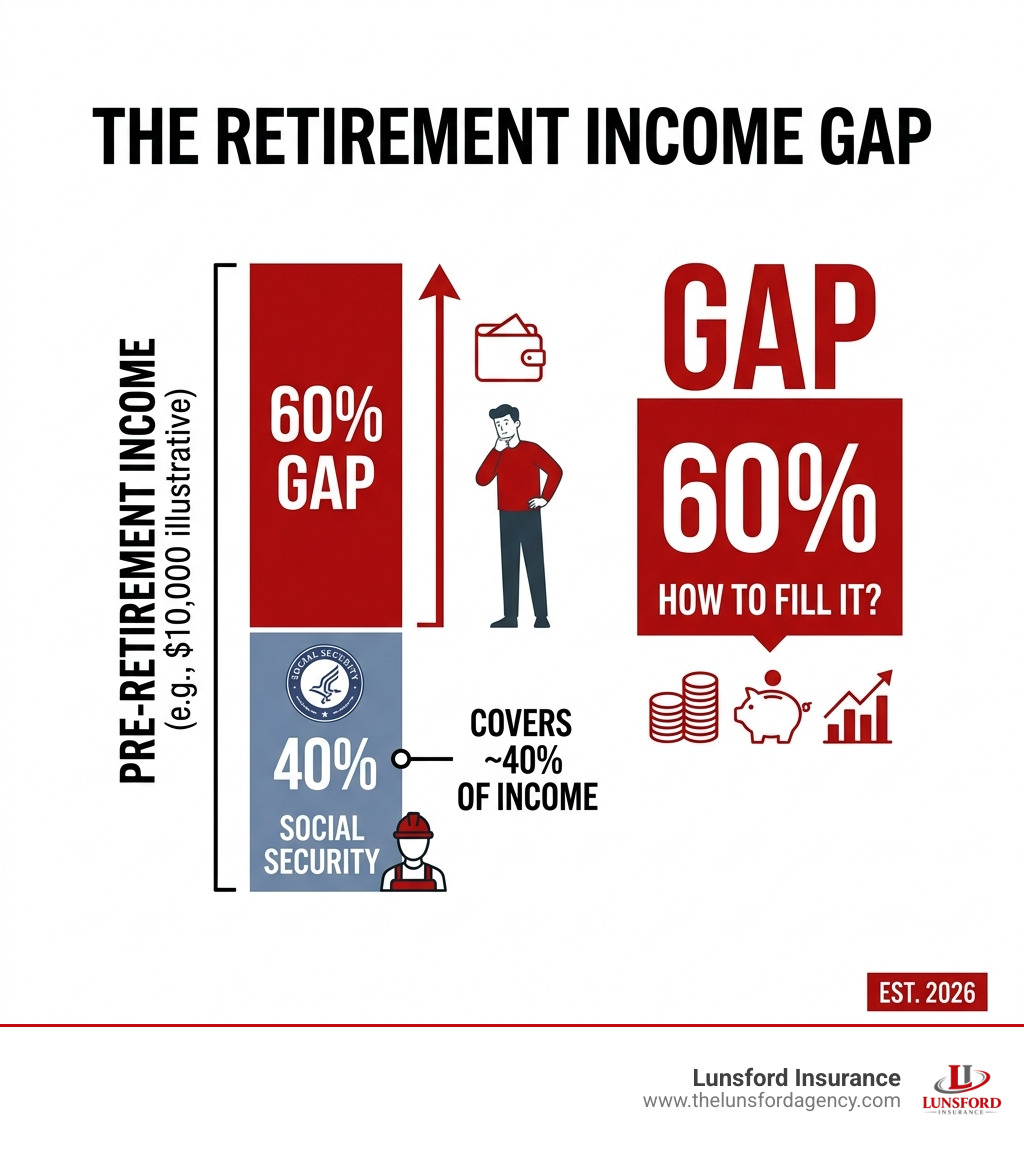
Most Americans count on Social Security as their main retirement income source. But the average benefit is only around $2,008 per month. That replaces roughly 40% of pre-retirement income — leaving a significant gap for the majority of retirees to fill on their own. At the same time, only 15% of private-sector workers still have access to a traditional pension. The math is sobering: longer lifespans, rising healthcare costs, and market volatility all put pressure on savings that most people have spent decades building.
The good news is that affordable tools exist to close that gap — including annuity options available right here in Ohio that can fit a range of budgets and timelines.
I’m Scott Lunsford, owner of The Lunsford Agency in Chillicothe, Ohio, with over 35 years of experience helping pre-retirees and retirees build reliable retirement income protection strategies using fixed and tax-deferred annuities. In this guide, I’ll walk you through the options that make the most sense for Ohio seniors looking for steady, affordable income they cannot outlive.
Mandatory Disclaimer: This is educational content only, not personalized tax/legal/investment advice. Rates/features subject to change. Guarantees backed by insurer’s claims-paying ability. Medicaid planning requires elder-law attorney review.
Key retirement income protection vocabulary:
Understanding the Risks to Your Retirement Income Protection

When we sit down with folks in Chillicothe or across Ohio, we often talk about the “Four Horsemen” of retirement. These aren’t spooky figures on horseback, but they can certainly feel like it if you aren’t prepared. These risks—longevity, inflation, market volatility, and healthcare—are the primary threats to your retirement income protection.
Longevity: The Risk of Living “Too Long”
It sounds funny to call a long life a “risk,” doesn’t it? We all want to see our grandkids grow up and maybe finally perfect our golf swing. However, from a financial perspective, longevity is a major variable. A 65-year-old woman today has an average life expectancy of 24 more years; for a man, it’s about 22 years. But remember, those are just averages—half of the population will outlive those numbers. If you plan for 20 years and live for 30, those last 10 years could be incredibly stressful without a guaranteed income stream.
Inflation: The Slow Erosion of Purchasing Power
Inflation is like a quiet leak in a tire. You might not notice it immediately, but eventually, you’re riding on the rims. Even at a modest average inflation rate of 2.7%, the cost of living doubles roughly every 25 years. If your income stays flat while the price of eggs and gas keeps climbing, your standard of living will inevitably drop. This is why we often look for 8 Ways to Protect Your Retirement Income that include inflation-hedging tools.
Sequence-of-Returns Risk
This is a fancy way of saying “bad timing.” If the stock market takes a nosedive right as you retire and you start pulling money out of a shrinking account, your portfolio may never recover. This is where a Services/Financial Planner Ohio/ becomes invaluable. We help you structure your assets so you aren’t forced to sell stocks when they are down just to pay your electric bill.
Calculating Your Personal Retirement Income Protection Needs
To build a shield, you first need to know how big the shield needs to be. We start by calculating the “retirement income gap.”
- List Essential Expenses: Housing, utilities, food, and insurance.
- Identify Guaranteed Income: Social Security and any private pensions.
- The Gap: If your essentials cost $4,000 a month and Social Security provides $2,008 (the national average), you have a $1,992 gap.
In Ohio, we have specific resources to help you understand your starting point. The Retirement Income – Ohio Department of Taxation provides guidance on how your various income streams are treated locally.
The Impact of Healthcare Costs on Ohio Seniors
Healthcare is often the largest “wildcard” in retirement. According to recent estimates, a 65-year-old individual may need $172,500 in after-tax savings just to cover healthcare expenses in retirement—and that excludes long-term care. For a couple, that number jumps to $315,000.
Furthermore, nearly 70% of those aged 65 and older will require some form of long-term care. In Ohio, the national median cost of a private room in a nursing home is approximately $127,750 per year. Without retirement income protection, a single health crisis can wipe out a lifetime of savings. We recommend checking the Life and Annuity – Ohio Department of Insurance for consumer protections and resources available to Buckeye State residents.
Affordable Annuity Types for Ohio Retirement Income Protection
If Social Security is the foundation of your retirement house, an annuity is often the sturdy frame. An annuity is essentially a contract between you and an insurance company: you give them a sum of money (either all at once or over time), and in exchange, they promise to give you a regular paycheck for life. It’s like buying your own personal pension.
Fixed Annuities: The “Safe Harbor”
For those who want zero surprises, fixed annuities are a popular choice. They offer a guaranteed interest rate for a set period. Think of them as a high-yield alternative to CDs, but with tax-deferred growth. As of March 2026, we are seeing fixed annuities quoted at 5.9% through select carriers (guaranteed for specified term by carrier’s claims-paying ability).
| Feature | Fixed Annuity | Traditional CD |
|---|---|---|
| Interest Rate | Often Higher (e.g., 5.9%) | Often Lower |
| Taxation | Tax-Deferred | Taxed Annually |
| Lifetime Income Option | Yes | No |
| Protection | State Guaranty Association | FDIC Insured |
(illustrative comparison only)
Fixed Indexed Annuities (FIA): A Balanced Approach
If you want some of the growth of the stock market but can’t stomach the thought of losing your principal, a Fixed Indexed Annuity (FIA) might be your best friend. FIAs credit interest based on the performance of a market index, like the S&P 500.
The magic of the FIA is the zero-percent floor. If the market drops 20%, your account value stays exactly where it is (minus any withdrawals). You don’t lose a dime of your principal to market losses. When the market goes up, you get a portion of that gain based on “participation rates” or “caps.” It’s a way to keep your retirement income protection intact while still having a chance to beat inflation. You can find more details on our Annuity Information/ page.
Immediate vs. Deferred Annuities
- Immediate Annuities (SPIA): You pay a lump sum and the checks start hitting your bank account right away (usually within 30 days). This is great for someone who just retired and needs to fill that income gap immediately.
- Deferred Annuities: You put money in now, let it grow tax-deferred, and start taking income years down the road. This is a powerful tool for younger seniors still in their “wealth accumulation years.”
For more on how these categories fit together, check out our category/annuities/ section.
Maximizing Yield While Minimizing Fees
One of the biggest concerns folks have about annuities is hidden fees. At The Lunsford Agency, we focus on products that are transparent and affordable. Many of the fixed and indexed annuities we work with do not charge explicit annual policy or administrative fees against your principal (standard surrender charges apply). This means your principal isn’t being chipped away by “maintenance” costs. There are no explicit annual fees charged against principal in these types of contracts, allowing your money to work harder for your retirement income protection.
Strategic Safeguards for Your Retirement Nest Egg
Protecting your income isn’t just about picking the right product; it’s about how you use it. We use a strategy called asset-liability matching. This means we take your “liabilities” (your essential bills) and match them with “guaranteed assets” (Social Security, pensions, and annuities). Any “surplus” money can then be invested more aggressively in the stock market for growth, because you know your light bill is already covered.
Sustainable Withdrawal Rates: The 4%-5% Rule
If you are pulling money from a 401(k) or IRA, you need to be careful not to empty the tank too fast. The traditional “4% rule” suggests that if you withdraw 4% of your starting balance in the first year and adjust for inflation thereafter, your money should last 30 years. However, in today’s volatile world, many experts suggest a more flexible approach. Combining systematic withdrawals with a Services/Annuities Ohio/ can provide a “floor” that makes your withdrawal strategy much safer. We compare these strategies in our Annuity Vs 401K Ultimate Guide To Choosing For Retirement/.
Medicaid Planning and Asset Protection in Ohio
As we age, the possibility of needing nursing home care becomes a reality. In Ohio, there are specific limits designed to protect the “community spouse” (the one staying at home) from becoming impoverished.
For 2026, the Community Spouse Resource Allowance (CSRA) ranges from $32,532 to $162,660. Additionally, the individual income limit is $2,982/mo, and for both spouses, it is $5,964/mo. Certain types of annuities may be used in some Medicaid planning strategies to help transform countable assets into an income stream for the community spouse. Because these rules are complex and change annually, we always advise consulting an elder-law attorney to ensure your plan is airtight. You can find more technical details in this PDF on Creditor Protection of Retirement Plan Assets.
The Role of ERISA and Private Pensions
The Employee Retirement Income Security Act (ERISA) is a federal law that sets minimum standards for most voluntarily established retirement and health plans in private industry. It’s designed to ensure that if your company promised you a pension, they have to manage the money fairly and keep you informed.
In Ohio, many public employees (like teachers or police officers) are covered by OPERS (Ohio Public Employees Retirement System). If you’re wondering What is OPERS?, it is a defined-benefit plan that provides a significant level of retirement income protection. However, even with OPERS, many retirees find they need to supplement their income to maintain their lifestyle.
Tax Advantages and Spending Freedom in Retirement
One of the “secret weapons” of annuities is their tax treatment.
- Tax-Deferred Growth: Unlike a CD or a savings account where you pay taxes on the interest every year, annuity earnings grow tax-deferred. This means you earn interest on your principal, interest on your interest, and interest on the money you would have otherwise paid in taxes.
- The Exclusion Ratio: When you turn an annuity into a stream of income, a portion of each check is considered a return of your original principal and is not taxed. Only the earnings portion is taxable. This can make your retirement paycheck much more efficient than taking fully taxable withdrawals from a traditional IRA.
QLACs: Deferring RMDs to Age 85
If you don’t need your Required Minimum Distributions (RMDs) right away, a Qualified Longevity Allowance Index (QLAC) allows you to take up to $210,000 (as of SECURE Act 2.0) out of your RMD calculations and defer that income until as late as age 85. This is a fantastic way to secure a “late-life” paycheck to cover potential nursing home costs while lowering your current tax bill.
Enhancing Quality of Life Through Protected Income
There is a fascinating psychological side to retirement income protection. Research shows that retirees with higher levels of protected income (like annuities or pensions) actually spend twice as much, on average, as those who rely solely on volatile investments.
Why? Because they have “permission” to spend. When you know a check is coming on the first of the month regardless of what the S&P 500 did, you book that trip to see the grandkids or upgrade your camper. It reduces “bag lady syndrome”—that nagging fear that you’ll run out of money if you treat yourself to a nice dinner. Our Services/Supplemental Retirement Plans Ohio/ are designed to give you that very freedom.
Frequently Asked Questions about Ohio Retirement
How do annuities compare to CDs for Ohio savers?
Annuities are often quoted higher than many current CD rates and offer the massive benefit of tax-deferred growth. For example, our 5.9% illustrative rate as of March 2026 (guaranteed for specified term by carrier’s claims-paying ability) often outpaces local bank offers. However, it’s important to remember that CDs are FDIC-insured and offer better short-term liquidity, whereas annuities are backed by the insurance company’s strength and typically have surrender charges for early withdrawal.
How does the 2026 CSRA limit affect my spouse?
In Ohio for 2026, the Community Spouse Resource Allowance (CSRA) ranges from $32,532 to $162,660. This is the amount of assets a spouse living at home can keep while the other spouse receives Medicaid assistance for long-term care. Certain annuity structures may be used in some Medicaid planning strategies to help protect assets above these limits, but you should always work with an expert to ensure compliance.
What is the difference between simplified and guaranteed issue for final expense?
If you are looking for life insurance to cover funeral costs, we offer two main paths:
- Simplified-Issue: You answer a few health questions, but there is no medical exam. These are generally more affordable.
- Guaranteed-Issue: No health questions and no exam. These have a “graded benefit,” meaning there is usually a 2-year waiting period before the full death benefit is paid for natural causes.
How does disability income protection affect my retirement?
Protecting your income before you retire is just as important as protecting it after. If you become disabled during your working years, your ability to save for retirement vanishes. We often recommend “own occupation” disability insurance to replace at least 65% of your income, ensuring your retirement contributions stay on track even if you can’t work.
Conclusion: Building Your Ohio Retirement Shield
Building a plan for retirement income protection doesn’t have to be overwhelming or expensive. At The Lunsford Agency, we pride ourselves on being a personalized brokerage. We aren’t tied to just one insurance company; we have strong connections across many carriers, which allows us to find the most affordable, high-yield options for our neighbors in Chillicothe and throughout Ohio.
Whether you are looking for a no-exam senior life policy or a fixed annuity to provide a “pension-like” paycheck, we are here to help you navigate the maze. You’ve worked hard for your money—now let’s make sure your money works hard for you, for as long as you need it.
Start your personalized retirement plan today with The Lunsford Agency
Mandatory Disclaimer: This is educational content only, not personalized tax/legal/investment advice. Rates/features subject to change. Guarantees backed by insurer’s claims-paying ability. Medicaid planning requires elder-law attorney review.
About the Author: Scott Lunsford is a veteran of the insurance industry with decades of experience in the Ohio market. Based in Chillicothe, The Lunsford Agency specializes in Medicare, long-term care, and affordable retirement income strategies for seniors. For more information, visit Uhrig Financial or our local office.