

How to Start Retirement Planning in Ohio
What Ohio Seniors Need to Know to Start Retirement Planning
Retirement planning for Ohio seniors is more achievable than most people think — especially with the state’s lower cost of living, favorable tax rules, and strong public pension systems working in your favor.
Here is a quick snapshot of what solid Ohio retirement planning looks like:
- Cost of living: Ohio’s overall cost of living runs 8–12% below the national average, with a median home price of $276,900 vs. $462,206 nationally (2025)
- Average annual spending: Ohio retiree households spend about $53,308 per year, compared to $57,818 nationally
- Social Security: Ohio fully exempts Social Security benefits from state income tax
- Savings target: A couple targeting $70,000/year needs roughly $545,050 in savings (after Social Security); a single retiree needs closer to $1,147,525
- Public pensions: Ohio has five public pension systems — OPERS, STRS, SERS, OP&F, and HPRS — each with rules that can significantly affect your retirement income
- Healthcare: An average 65-year-old couple should plan for roughly $295,000 in lifetime medical costs
- Free help: Resources like Pro Seniors’ Pension Rights Project offer free legal guidance on pensions and retirement decisions for Ohio residents
The goal of this guide is to walk you through each of these areas step by step — from estimating your expenses to choosing the right Medicare coverage and income strategy.
I’m Scott Lunsford, owner of The Lunsford Agency in Chillicothe, Ohio, with over 35 years of experience helping Ohio pre-retirees and retirees with retirement planning for Ohio seniors — including annuities, 401(k) rollovers, life insurance, and safe money strategies. Let’s get into everything you need to build a retirement plan that fits your life.
Mandatory Disclaimer: Rates shown are examples only, not guaranteed offers, and subject to carrier, age, and timing. Annuity guarantees are backed by the claims-paying ability of the issuing insurance company. Fixed Index Annuity (FIA) caps, participation rates, and spreads may change annually. This information is for educational purposes only and does not constitute legal, tax, or investment advice. Please consult a qualified professional or elder-law attorney regarding specific Medicaid planning or tax strategies.
Easy retirement planning ohio seniors word list:
Cost of Living and Tax Advantages for Retirement Planning in Ohio Seniors
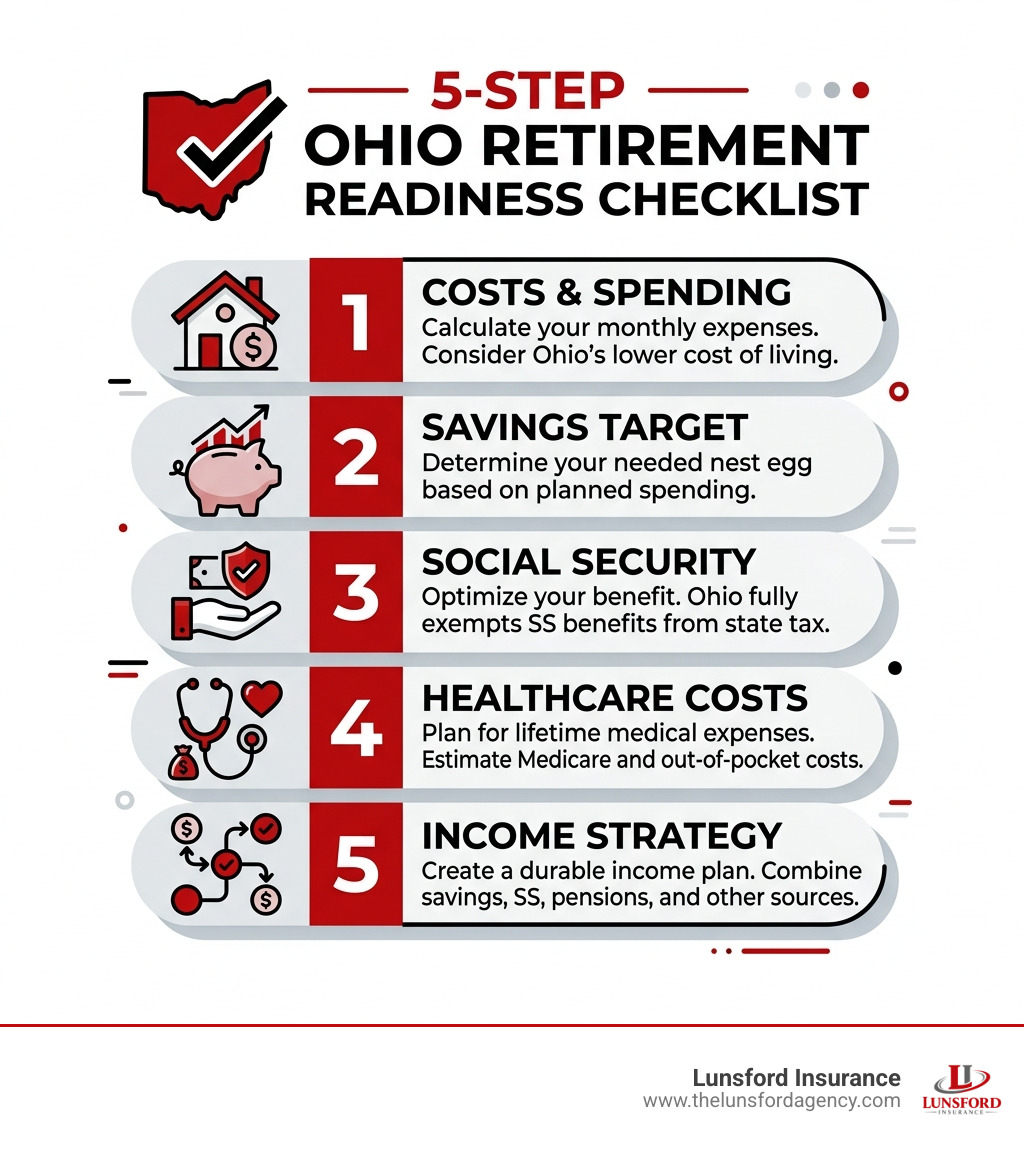
When we sit down with folks in Chillicothe or Columbus, the first thing we look at is the “Ohio advantage.” Living in the Buckeye State means your dollar simply goes further.

Ohio’s cost of living is consistently 8% to 12% below the national average. This is largely driven by housing costs; while the national median home price has soared past $460,000, Ohio’s median remains a much more manageable $276,900. For many retirement planning Ohio seniors, this presents a golden opportunity to downsize, unlock home equity, and eliminate a mortgage before the “gold watch” ceremony.
| Expenditure Category | Ohio Average (Annual) | National Average (Annual) |
|---|---|---|
| Housing | $9,166 | $11,692 |
| Healthcare | $7,640 | $7,540 |
| Total Household Spending | $53,308 | $57,818 |
By keeping these costs low, you can focus your resources on the things that actually matter—like visiting grandkids or finally taking that trip to the Hocking Hills. If you need help mapping these numbers to your specific situation, working with a financial planner in Ohio can help clarify your trajectory.
Estimating Savings for Retirement Planning in Ohio Seniors
How much is “enough”? While national headlines often scream that you need $1.46 million to retire, the reality for retirement planning Ohio seniors is often more modest.
We often use the “4% Rule” as a starting point—suggesting you can safely withdraw 4% of your nest egg annually, adjusted for inflation. However, for a more resilient plan, we look at “Guyton-Klinger Guardrails.” This method allows for higher withdrawals when the market is up but suggests pulling back slightly during lean years to protect your principal.
For a comfortable $70,000 annual budget in Ohio:
- Couples: After accounting for average Social Security ($48,198 combined), you may only need about $545,050 in personal savings.
- Singles: With a single Social Security check ($24,099), the savings gap grows, requiring roughly $1,147,525 to hit that same $70k goal.
Don’t let these numbers intimidate you. There are many retirement resources and tools available through the Ohio Treasurer’s office to help you calculate your specific “gap.”
State-Specific Benefits for Retirement Planning in Ohio Seniors
Ohio loves its seniors, and the tax code proves it. First and foremost, Ohio fully exempts Social Security benefits from state income tax. That’s an immediate “raise” compared to living in states that take a cut of your federal checks.
Furthermore, Ohio offers several key credits:
- Retirement Income Credit: Can provide up to $200 in tax relief based on your qualified retirement income.
- Senior Citizen Credit: A $50 credit for those 65 and older.
- Homestead Exemption: This is a big one. If you are 65+ (or disabled) and meet income requirements, you can shield up to $25,000 (or $29,000 for some veterans) of your home’s market value from local property taxes. In a state with an average property tax rate of 1.41%, this adds up to significant annual savings.
Maximizing Social Security and Ohio Public Pensions
Timing is everything. You can apply for Social Security as early as 62, but your monthly check will be permanently reduced. If you wait until your Full Retirement Age (FRA)—usually 66 or 67—you get 100% of your earned benefit. But here’s the kicker: if you delay until age 70, your benefit increases by about 8% for every year you wait past your FRA.
For retirement planning Ohio seniors who choose to keep working part-time, be aware of the earnings limits. If you haven’t reached FRA yet, the SSA may withhold $1 in benefits for every $2 you earn over the annual limit. Once you hit FRA, those limits disappear, and your benefit is recalculated to “give back” what was withheld.
Ohio Public Pension Systems
Ohio is unique because of its robust public pension systems. Whether you are part of OPERS (Public Employees), STRS (Teachers), or SERS (School Employees), your pension is likely the cornerstone of your plan.
Maximizing these benefits often comes down to your “Final Average Salary” (FAS). Most systems look at your three or five highest years of earnings. We call the 2–3 years before you stop working the “Retirement Red-Zone.” This is the time to ensure you aren’t leaving money on the table. If your pension doesn’t quite cover your desired lifestyle, we can explore supplemental retirement plans to bridge the gap.
Healthcare, Medicare, and Long-Term Care Planning
Healthcare is often the “X-factor” in retirement. A 65-year-old couple today might need nearly $300,000 just to cover medical expenses throughout their golden years.
Most retirement planning Ohio seniors will transition to Medicare at age 65.
- Part A & B: Your basic hospital and medical coverage.
- Medigap (Supplement): Helps pay the “gaps” like deductibles and co-pays.
- Medicare Advantage (Part C): An all-in-one private alternative to original Medicare.
Choosing between these can be a headache, which is why we offer specialized Medicare services to help you compare plans in your specific Ohio county.
Managing Long-Term Care and Medicaid Limits
No one likes to think about nursing homes, but long-term care (LTC) is a reality for many. In Ohio, Medicaid has strict financial limits if you need state assistance for LTC.
For 2026, the Community Spouse Resource Allowance (CSRA) ranges from $32,532 to $162,660. The income limit for a single individual is $2,982/mo, while a couple has a combined limit of $5,964/mo. Certain financial products, like specific annuities, may be used in some Medicaid planning strategies to help protect assets for a healthy spouse. However, we always recommend an elder-law attorney consultation to ensure you are following the latest state regulations.
Strategic Income: Annuities and Withdrawal Rules
Once you stop receiving a paycheck, you need to create your own. This involves a strategic withdrawal plan: usually starting with taxable accounts, then tax-deferred (like 401ks), and finally tax-free (Roth IRAs).
Annuities have become a popular tool for retirement planning Ohio seniors because they provide a “pension-like” stream of income that you cannot outlive. If you’re debating between keeping your money in a market-based account or moving to a guaranteed stream, check out our Annuity vs 401k guide for a deep dive into the pros and cons.
Annuities as a High-Yield Alternative
In the current economic climate, many seniors are looking for alternatives to traditional CDs. Fixed annuities are often quoted higher than many current CD rates, offering tax-deferred growth that CDs can’t match.
For example, we have seen fixed annuities quoted at 5.9% as of March 2026 (guaranteed for specified term by carrier’s claims-paying ability). These products typically feature:
- No explicit annual fees charged against principal.
- No ongoing policy or administrative fees (standard surrender charges apply).
- Fixed Index Annuities (FIA) that offer potential for higher growth, though caps and participation rates may change annually.
Rates shown are examples only, not guaranteed offers, and subject to carrier, age, and timing.
For more details on how these fit into your portfolio, you can browse our annuity information and types page.
Final Expense and Legacy Protection for Ohio Families
The final piece of retirement planning Ohio seniors is legacy. Since Ohio repealed its estate tax in 2013, you can pass on more of your hard-earned wealth to your children and grandchildren without the state taking a bite.
However, the cost of a funeral and final medical bills can still be a burden. We specialize in providing life insurance in Ohio that is designed specifically for seniors who want to lock in a rate that never increases.
The 4-Step Final Expense Process
Getting coverage doesn’t have to be complicated. Our process involves four simple steps:
- Choose your coverage amount: Typically between $3,000 and $50,000.
- Select your policy type:
- Simplified-issue: Requires answering a few health questions but has no medical exam.
- Guaranteed-issue: No health questions at all, though it typically features “graded benefits” (a 2-year waiting period for full payout).
- Lock in your premium: Your rate is fixed for life.
- Designate a beneficiary: They receive a tax-free lump sum to handle your final arrangements.
Frequently Asked Questions
Is $500,000 enough to retire in Ohio?
It certainly can be! Because Ohio’s cost of living is roughly 10% lower than the national average, $500,000 plus average Social Security can provide a very stable lifestyle, especially if your home is paid off and you utilize Ohio’s senior tax credits.
Does Ohio tax Social Security benefits?
No. Ohio is one of the states that fully exempts Social Security retirement benefits from state income tax. This is a major win for retirement planning Ohio seniors.
What are the 2026 Medicaid income limits for Ohio seniors?
For 2026, the single income limit for Medicaid long-term care eligibility is $2,982/mo. For a married couple where both are applying, the limit is $5,964/mo. These figures update annually, so always verify with a professional.
Conclusion
Retirement planning for Ohio seniors isn’t just about a “magic number.” It’s about building a personalized roadmap that accounts for the unique benefits of living in the Buckeye State. From the Homestead Exemption to the stability of OPERS and the high-yield potential of modern annuities, you have the tools to retire with confidence.
At The Lunsford Agency, we’ve spent three decades helping our neighbors in Chillicothe and across Ohio navigate these choices. We specialize in affordable, no-exam senior policies and personalized brokerage services that connect you with the strongest carriers in the industry.
Ready to see how the numbers look for you? Start your Ohio retirement plan today and let us help you protect what you’ve built.
Mandatory Disclaimer: Rates shown are examples only, not guaranteed offers, and subject to carrier, age, and timing. Annuity guarantees are backed by the claims-paying ability of the issuing insurance company. Fixed Index Annuity (FIA) caps, participation rates, and spreads may change annually. This information is for educational purposes and does not constitute legal, tax, or investment advice. Please consult with a qualified professional or elder-law attorney regarding specific Medicaid planning or tax strategies.