

A Practical Guide to OLHIGA for LTC Insurance Without Exam
Does LTC Insurance Without a Medical Exam Actually Exist in Ohio?
LTC insurance without a medical exam is available to most Ohio residents — and it’s more accessible than many people realize. Here’s a quick overview of what you need to know:
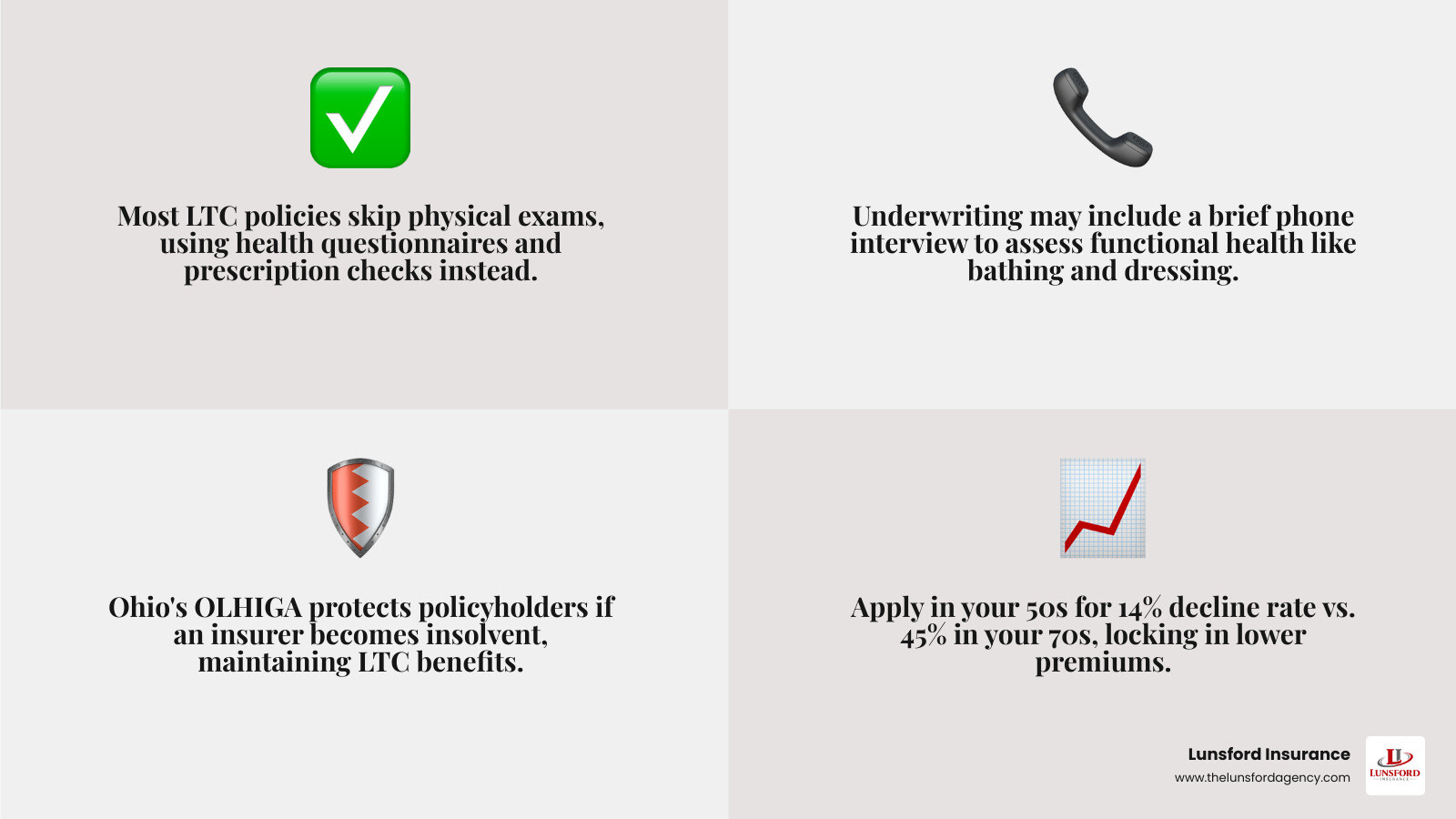
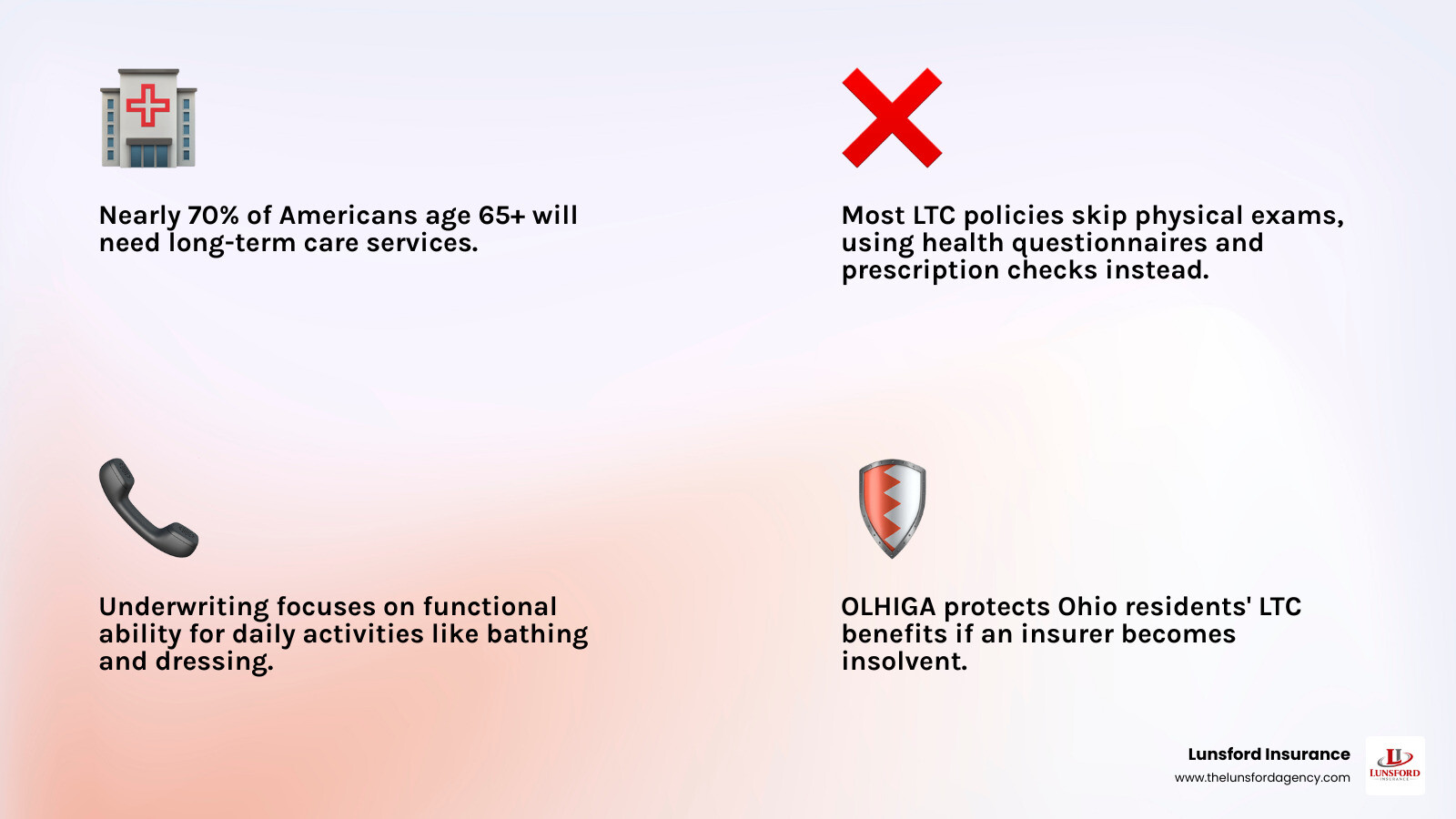
- Most LTC policies do not require a traditional physical exam. Insurers typically use health questionnaires, prescription history checks, and sometimes a brief phone interview instead.
- No-exam options include traditional simplified-issue LTC policies, hybrid life/LTC policies, and asset-based linked-benefit products.
- Eligibility still depends on your health history. Common disqualifying conditions include Alzheimer’s, Parkinson’s, or current need for assistance with daily activities — but many applicants with manageable health conditions do qualify.
- The best time to apply is in your 50s, when approval rates are higher and premiums are lower. Decline rates rise sharply with age — from about 14% in your 50s to nearly 45% by your 70s.
- Ohio residents may also have an additional layer of protection through the Ohio Life & Health Insurance Guaranty Association (OLHIGA), which can help maintain benefits if a licensed insurer becomes insolvent.
Nearly 70% of Americans who reach age 65 will need some form of long-term care during their lifetime. That’s not a small risk — it’s closer to a probability. Yet many Ohio seniors delay planning because they assume the application process is invasive, expensive, or simply out of reach once their health starts to change.
The reality is more encouraging. Long-term care underwriting works differently from life insurance underwriting. Rather than assessing mortality risk through blood draws and physical exams, LTC insurers focus on your functional health — specifically, whether you can independently perform everyday activities like bathing, dressing, and eating. That functional focus is exactly why most LTC carriers can make underwriting decisions without ever asking you to visit a clinic.
This guide is written specifically for Ohio residents who want to understand how no-exam LTC insurance works, what OLHIGA protections may apply to those policies, and how to find coverage that fits your situation and budget.
A note on who wrote this: I’m Scott Lunsford, founder of The Lunsford Agency in Chillicothe, Ohio, and I’ve been licensed in insurance and financial services since 1988. Over more than three decades of helping retirees and pre-retirees protect their assets, I’ve guided many clients through the process of securing LTC insurance without a medical exam — and I’ve seen how the right policy at the right time can protect both a family’s finances and its peace of mind. In the sections ahead, I’ll walk you through everything you need to know to make a confident, informed decision.
Summary of LTC Planning in Ohio
Planning for long-term care in Ohio is about more than just finding a policy; it’s about securing your legacy and ensuring you won’t outlive your savings. In May 2026, the costs of care continue to rise. A private room in an Ohio nursing home can easily exceed $127,000 annually, while home health aide services often cost upwards of $60,000 per year. Since nearly 70% of us will need some form of help, the question isn’t usually if you’ll need care, but how you’ll pay for it.

Many of our neighbors in Chillicothe and across Ohio are surprised to learn that Medicare does not cover most long-term care costs. It typically only covers short-term skilled nursing after a hospital stay. This leaves most families to choose between self-funding, which can quickly deplete a lifetime of savings, or Long-Term Care Specialists: A Guide to Future-Proofing Your Health to bridge the gap.
OLHIGA Definition and Purpose
When we talk about LTC insurance without a medical exam, we also need to talk about what happens if the insurance company itself runs into trouble. This is where the Ohio Life & Health Insurance Guaranty Association (OLHIGA) comes into play.

OLHIGA acts as a safety net where insurance companies pool resources to pay claims if one fails. This protection typically ensures that Ohio residents may have their benefits maintained even if a provider faces financial insolvency. Think of it like the FDIC for your bank account, but for your insurance policies. It is a statutory protection created by Ohio law to provide a final layer of security for policyholders.
For those looking at asset-based products, you might hear this referred to as an “Ohio annuity guarantee” in shorthand, though its formal role covers life and health products as well. You can find more details on state-level oversight through the Long-Term Care – Ohio Department of Insurance or by reviewing our Services / Long-Term Care Insurance Ohio page.
How OLHIGA Protects LTC Insurance Without Medical Exam Policies
If you choose a policy that offers a simplified application process, you aren’t sacrificing your safety net. Insolvency coverage provided by OLHIGA generally extends to all “member insurers”—which includes most companies licensed to sell life and health insurance in the state of Ohio.
Whether you have a traditional policy or a hybrid one, the protection typically applies to Ohio residents at the time the insurer is declared insolvent and liquidated. This means that LTC insurance without a medical exam—which often falls under “simplified issue” or “accelerated underwriting”—is usually treated with the same statutory seriousness as a policy that required a full physical.
Residency and Eligibility for Ohio Protection
To benefit from this safety net, residency is the primary factor. OLHIGA protection is generally available to people who are residents of Ohio at the time an insurance company is found to be insolvent and is ordered to be liquidated by a court.
If you live in Chillicothe or anywhere else in the Buckeye State, you are likely covered. Eligibility is tied to the policyholder’s status as a resident. If you move out of state later, you would typically look to the guaranty association in your new state of residence for protection. For a deeper dive into the logistics of these rules, check out our guide on How to Master Long-Term Care Planning in Ohio.
Eligibility Criteria for LTC Insurance Without Medical Exam
While OLHIGA protects you from the insurer failing, you still have to “qualify” for the insurance itself. The beauty of LTC insurance without a medical exam is that the “exam” is replaced by data. We typically see insurers use:
- Health Questionnaires: Detailed questions about your medical history.
- Prescription History: A review of national databases to see what medications you’ve been prescribed.
- MIB Reports: A check of your previous insurance applications.
- Cognitive Interviews: For those over 65, a 15-minute phone call to check memory and comprehension.
These policies allow for coverage without a physical exam, though eligibility for OLHIGA protection may apply based on the insurer’s membership status. To understand the limits of what these policies can pay out, see The Ultimate Guide to Long-Term Care Insurance Maximums.
Coverage Limits and Verified Caps
OLHIGA does not provide unlimited coverage. There are specific “caps” or limits on how much the association will pay if an insurer fails. These are current statutory limits as of May 2026 and are subject to change based on Ohio law.
| Policy Type | OLHIGA Coverage Limit (Verified Caps) |
|---|---|
| Long-Term Care Insurance | $300,000 (Current Statutory Limit) |
| Life Insurance Death Benefit | $300,000 (Current Statutory Limit) |
| Annuity Present Value | $250,000 (Current Statutory Limit) |
| Health Insurance | Up to $500,000 (depending on type) |
Note: These figures are illustrative examples of statutory protections and depend on the specific product and situation.
If your LTC policy has a “pool of money” worth $500,000, and the company fails, OLHIGA typically covers up to the $300,000 cap. This is why some people choose to spread their coverage across multiple member insurers or focus on companies with high financial strength ratings. You can learn more about how these limits interact with different plans in our article on Essential Coverage Types for Long-Term Care in Ohio.
Exclusions and the Insolvency Process
Not everything is covered by the safety net. It is important to remember that protection typically does not extend to portions of policies where the risk is borne by the policyholder.

Key Exclusions
- Non-Guaranteed Elements: If your policy has “dividends” or “interest” that isn’t guaranteed, those portions may not be covered.
- Unlicensed Entities: If you buy from a company not licensed in Ohio, you have no OLHIGA protection.
- Self-Funded Plans: Employer plans that are “self-insured” are not covered by the state guaranty association.
- Burial Insurance: While often marketed separately, this is correctly identified as life insurance and falls under life insurance caps, not annuity or health caps.
The Insolvency Process
If an insurer fails, the process typically follows these steps:
- Liquidation: A court declares the company insolvent.
- Assessment: OLHIGA assesses its member companies to raise the funds needed to pay claims.
- Claim Handling: OLHIGA either pays the claims directly or arranges for another insurance company to take over the policies.
This process is designed to be seamless for the policyholder, but it can take time. Having an agent who understands the local authority and can guide you through these transitions is invaluable.
Local Authority and Professional Guidance
Navigating LTC insurance without a medical exam can feel like a maze, especially when you add the technical layers of OLHIGA protections. That’s why working with a local Ohio brokerage is so important.

At Lunsford Insurance, we specialize in affordable, no-exam senior policies. We aren’t tied to just one company; we have strong connections across many carriers, allowing us to find the best fit for your health profile and budget. We provide personalized planning to help you understand how the Ohio annuity guarantee (shorthand for these protections) may apply to specific long-term care products you are considering.
Whether you are in Chillicothe or anywhere else in Ohio, our goal is to make sure you aren’t just “covered,” but “protected.”
Frequently Asked Questions about LTC Insurance Without Medical Exam
What is the maximum OLHIGA coverage for LTC?
Currently, the statutory limit for long-term care insurance benefits through OLHIGA is $300,000 per person. This limit applies to the total of all LTC claims for a single individual, regardless of how many policies they hold with the insolvent company.
Does OLHIGA cover all no-exam policies?
It covers policies issued by “member insurers.” Most reputable companies offering LTC insurance without a medical exam in Ohio are member insurers. However, some “alternative” products or non-insurance health sharing plans may not qualify. Always ask your agent if the carrier is an OLHIGA member.
How do I verify if my insurer is a member?
You can check the official OLHIGA website or contact the Ohio Department of Insurance. Most licensed carriers are required to be members as a condition of doing business in the state.
Conclusion
Securing your future doesn’t have to involve needles, doctors’ offices, or endless paperwork. LTC insurance without a medical exam offers a streamlined, dignified way to protect your assets from the high cost of care. And with the Ohio Life & Health Insurance Guaranty Association (OLHIGA) serving as a safety net, you can have peace of mind knowing that the state has a system in place to protect you if your insurer hits a rough patch.
The 70% chance of needing care is a reality we all face. By acting in your 50s or early 60s, you can lock in lower rates and ensure that your family isn’t left with the emotional and financial burden of a care crisis.
Disclaimer: Coverage, eligibility, and limits depend on the specific product, situation, and Ohio regulations. Figures provided are illustrative of current statutory caps and are not a guarantee of future benefits.
If you’re ready to explore your options without the hassle of a medical exam, we’re here to help. Secure your future with Long-Term Care Insurance in Ohio today.