

The Best Supplemental Retirement Plans for Ohio Workers
Understanding Supplemental Retirement Plans Ohio
Supplemental retirement plans in Ohio workers can access fall into several clear categories. Here is a quick overview to match your situation:
| Plan Type | Who It’s For | 2026 Base Limit | Early Withdrawal Penalty |
|---|---|---|---|
| 403(b) SRA | Public school/university employees | $24,500 | Yes (10% before age 59½) |
| 457(b) / Ohio Deferred Compensation | All Ohio public employees | $24,500 | No |
| OPERS Additional Annuity | OPERS Traditional Pension members | No annual limit (rollover) | Possible (before age 59½) |
| Fixed Annuity (individual) | Any Ohio resident | No IRS cap | Varies by contract |
| Alternative Retirement Plan (ARP) | Higher education employees | Varies | Varies |
Illustrative comparison only. Coverage amounts, rates, and availability vary by carrier, age, and location.
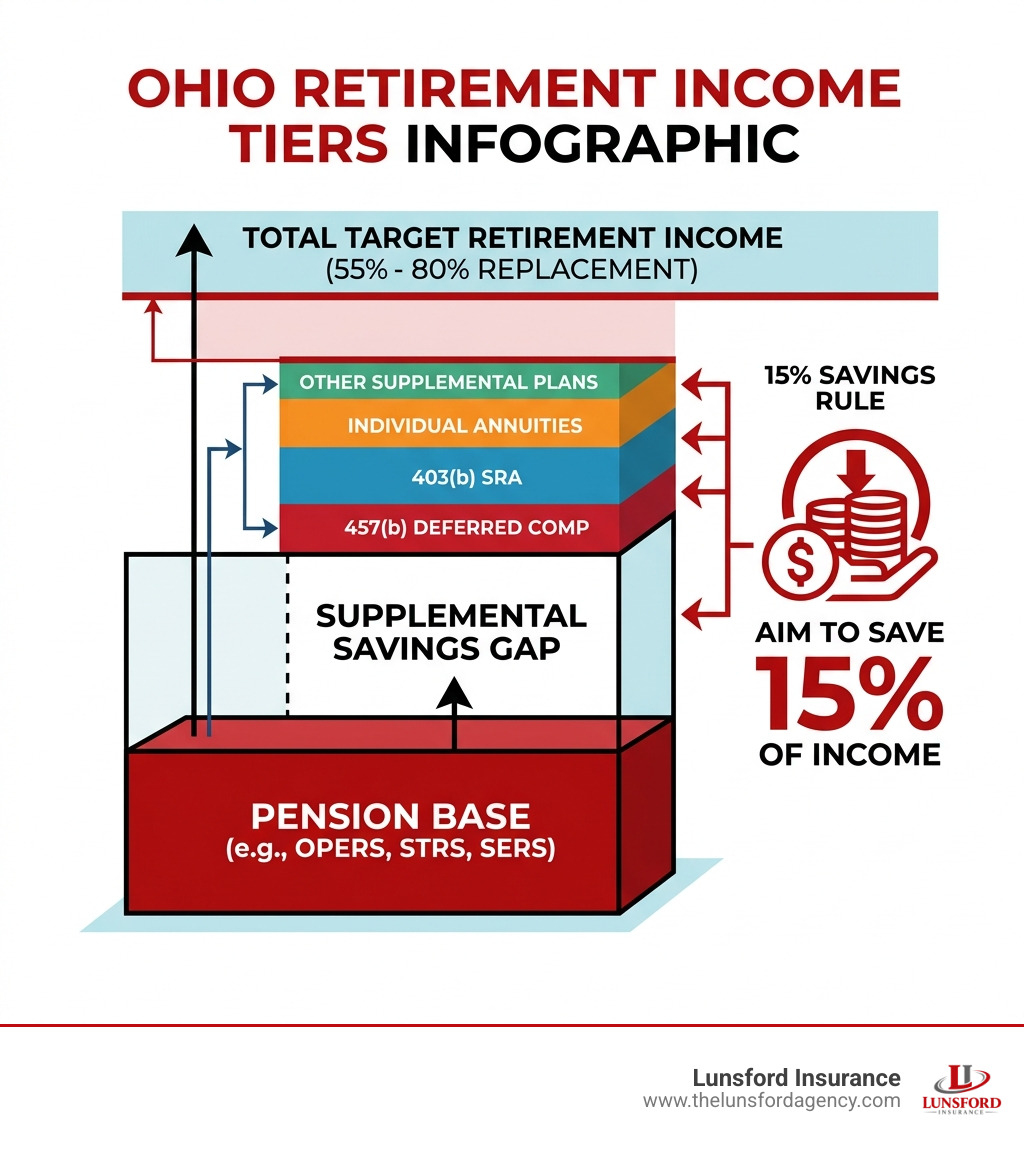
Most Ohio public employees rely on a pension from OPERS, STRS, or SERS as their foundation. But a pension alone often does not replace enough income. Experts generally suggest replacing 55% to 80% of your pre-retirement income to maintain your lifestyle. For many retirees, that gap needs to be filled with something extra.
That is exactly what supplemental plans are designed to do. Whether you are a teacher, a state worker, or a university employee, Ohio offers several strong options to save more, pay less in taxes now or later, and build a more secure retirement.
I am Scott Lunsford, owner of The Lunsford Agency in Chillicothe, Ohio, with over three decades of experience helping Ohio workers and retirees navigate supplemental retirement plans Ohio residents can realistically use. In this guide, I will walk you through each option clearly so you can choose what fits your situation best.
Rates shown are examples only, not guaranteed offers, and subject to carrier, age, and timing. Coverage amounts, rates, and availability vary by carrier, age, and location. Annuity rates of 5.9% are illustrative as of March 2026 and are guaranteed for a specified term by the carrier’s claims-paying ability. Supplemental plans may be used in some Medicaid planning strategies; however, you should always consult an elder-law attorney for specific legal advice. Life insurance eligibility is subject to policy terms and carrier approval standards. Graded Death Benefit terms vary by carrier; always review policy details. Many policies offer a free look period (typically 30 days).
Supplemental retirement plans ohio vocab explained:
When we talk about retirement in the Buckeye State, we usually start with the big three: the Ohio Public Employees Retirement System (OPERS), the State Teachers Retirement System (STRS), and the School Employees Retirement System (SERS). While these systems provide a fantastic foundation, they aren’t always enough to cover the “income gap”—that space between what your pension pays and what you actually need to live comfortably.
At Lunsford Insurance, we see many folks who assume their pension is a “set it and forget it” solution. However, inflation and rising healthcare costs can eat away at that fixed income. By utilizing supplemental retirement plans Ohio provides, you can take advantage of voluntary contributions and the power of compounding growth. Whether you are looking at retirement planning services or exploring Ohio State University’s SRA overview, the goal is the same: building a secondary bucket of money that you control.
Why Ohio Public Employees Need Extra Savings
Pension limits are real. Most public employees in Ohio contribute about 10% to 13% of their salary into their mandatory system, but those benefits are often capped based on years of service and final average salary. Supplemental savings act as a hedge against inflation and help maintain your lifestyle. If you want to travel, help grandkids with college, or simply ensure you can afford the best medical care, having an extra source of income is vital. If you’re unsure where to start, speaking with a financial planner in Ohio can help you map out exactly how much “extra” you might need.
Maximizing Supplemental Retirement Plans in Ohio for Educators
For our educators, STRS Ohio provides a substantial benefit, but the STRS supplemental savings options are where the real growth happens. Teachers often have access to 403(b) plans through various vendors. One unique perk for long-term educators is the “15-year catch-up” provision, which allows those with 15 or more years of service with the same employer to contribute an additional $3,000 per year (up to a $15,000 lifetime limit) if they haven’t maxed out in previous years.
Ohio Deferred Compensation and 457(b) Strategies
One of the most powerful tools available to all Ohio public employees is the Ohio Deferred Compensation (ODC) 457(b) plan. Unlike a 403(b) or a private 401(k), the 457(b) is specifically designed for public service workers.
The biggest “superpower” of the 457(b) is that there is no 10% early withdrawal penalty if you separate from service before age 59½. If you retire at 55, you can start taking distributions immediately without the IRS taking an extra 10% cut. This makes it an ideal bridge for those planning to retire before the standard age. You can even contribute “leave cash-outs” (unspent sick or vacation time) into your 457(b) to lower your final tax bill. For more on how to use these tools, Ohio Deferred Compensation resources offer excellent planning basics.
2026 Contribution Limits and Catch-Up Provisions
Staying on top of IRS limits is key to maximizing your growth. For 2026, the contribution landscape allows for significant tax-advantaged saving.
| Limit Type | 403(b) Limit (2026) | 457(b) Limit (2026) |
|---|---|---|
| Base Contribution (Under Age 50) | $24,500 | $24,500 |
| Age 50+ Catch-Up | $8,000 ($32,500 total) | $8,000 ($32,500 total) |
| Special Age 60-63 Catch-Up | $11,250 ($35,750 total) | $11,250 ($35,750 total) |
| Traditional 3-Year Catch-Up | N/A | Up to $49,000 |
Coverage amounts, rates, and availability vary by carrier, age, and location.
The “Traditional Catch-Up” for 457(b) plans is a hidden gem. If you are within three years of your “normal retirement age” and didn’t contribute the maximum in previous years, you might be able to double your base limit, reaching up to $49,000 in 2026.
Enrollment and Management for State Employees
For state and university employees, managing these accounts is usually handled through portals like NetBenefits (Fidelity) or ohio457.org. Ohio State University, for example, uses a tiered investment approach, allowing you to choose “Do it for me” (Target Date Funds) or “Build your own” options. You can find the full SRA slide guide through OSU Human Resources to see the specific provider list, which includes names like TIAA, Corebridge, and Voya.
Higher Education and Alternative Retirement Plans (ARP)
If you work for an Ohio public university or college, you might encounter the Alternative Retirement Plan (ARP) under Ohio Revised Code Chapter 3305. When you’re hired, you have a 120-day window to decide: do you want the state pension (OPERS/STRS), or do you want a defined contribution plan (the ARP)?
This is an irrevocable election. If you choose the ARP, you are essentially managing your own “401(k)-style” account. The Ohio Revised Code Chapter 3305 outlines how the Ohio Board of Regents selects vendors. This is a great choice for those who want portability—if you move to a university in another state, your ARP balance goes with you.
Individual Supplemental Retirement Plans in Ohio
Not everyone wants to deal with the stock market’s roller coaster. For those seeking stability, individual annuities serve as excellent high-yield CD alternatives.
As of March 2026, we are quoting fixed annuities at 5.9% through select carriers (guaranteed for the specified term by the carrier’s claims-paying ability). These plans offer:
- Principal Protection: Your initial investment is shielded from market losses.
- No Ongoing Administrative Fees: Unlike many mutual funds in 403(b) plans, these specific annuity structures often have no explicit annual fees charged against your principal.
- Tax Deferral: You don’t pay taxes on the growth until you take the money out.
If you’re torn between a standard workplace plan and an annuity, check out our Annuity vs. 401(k) guide to see which fits your risk tolerance.
OPERS Additional Annuity Program
If you are a member of the OPERS Traditional Pension Plan, you have access to the Additional Annuity Program. This is a voluntary savings vehicle where you can make after-tax deposits (as low as $15) or roll over money from other qualified plans. The funds are invested in the OPERS Stable Value Fund. At retirement, this “extra” bucket of money is turned into an additional monthly check for life—giving you two “pensions” instead of one!
Strategic Planning: Medicaid, LTC, and Final Expenses
Retirement isn’t just about saving; it’s about protecting what you’ve saved. In Ohio, we have specific limits for Medicaid planning that you should be aware of. For 2026, the Community Spouse Resource Allowance (CSRA) ranges from $32,532 to $162,660. Income limits for Medicaid eligibility are set at $2,982/month for a single person and $5,964/month for both spouses.
Supplemental plans, including certain annuities, may be used in some Medicaid planning strategies to help protect assets for a healthy spouse. However, these are complex legal waters; we always recommend you consult an elder-law attorney for specific advice.
Guaranteed Issue Life Insurance and Final Expenses
Many retirees realize too late that their workplace life insurance ends when they stop working. To protect your family from burial costs (which now average over $8,000 in many parts of Ohio), we utilize a simple 4-step final expense process:
- Choose your coverage amount (usually $5,000 to $25,000).
- Select your policy type (Simplified-issue or Guaranteed-issue).
- Pay your fixed premiums (they never go up).
- Beneficiary receives the payout (tax-free and usually within days).
We offer guaranteed issue life insurance where no medical exam is required, and processing typically takes just days. For guaranteed-issue policies, a 2-year waiting period usually applies, during which a “Graded Death Benefit” is in effect. Most of our policies also offer a 30-day free look period so you can review the details with your family risk-free.
Managing Required Minimum Distributions (RMDs)
Once you hit age 73, the IRS wants their share. You must begin taking Required Minimum Distributions (RMDs) from your 403(b), 457(b), and traditional IRAs. Calculating these involves dividing your year-end account balance by a “distribution period” based on your age. To avoid tax surprises, you can use Form W-4R to manage your federal tax withholding on these payments. You can learn more about our team and how we assist with these transitions on our about page.
Frequently Asked Questions about Ohio Retirement
Can I contribute to both a 403(b) and a 457(b) in Ohio?
Yes! This is one of the best “hacks” for Ohio public employees. Because these plans fall under different sections of the tax code, their limits do not coordinate. In 2026, a worker under age 50 could theoretically contribute $24,500 to a 403(b) and $24,500 to a 457(b), deferring a total of $49,000 in a single year.
What are the early withdrawal penalties for Ohio supplemental plans?
For 403(b) plans, there is typically a 10% IRS penalty if you take money out before age 59½. For the Ohio Deferred Compensation 457(b) plan, there is no 10% penalty as long as you have separated from your employer, regardless of your age.
How do I roll over my old 401(k) into Ohio Deferred Compensation?
It’s a straightforward process. You’ll need to contact ODC at ohio457.org to get a rollover contribution form. Then, contact your old 401(k) provider to initiate a “direct rollover” to ODC. This keeps the money tax-deferred and consolidates your accounts for easier management.
Conclusion
Navigating supplemental retirement plans Ohio workers have at their disposal doesn’t have to be a headache. Whether you’re looking for the tax-free growth of a Roth 457(b), the safety of a 5.9% fixed annuity, or the lifelong security of the OPERS Additional Annuity, the key is to start now.
At Lunsford Insurance, we pride ourselves on being a personalized brokerage. We don’t just work for one company; we have strong carrier connections that allow us to find the most affordable, no-exam policies and high-yield retirement tools for our neighbors in Chillicothe and across Ohio.
Ready to bridge your retirement gap? Explore our resource library or contact us today to build your own custom supplemental retirement strategy.
Mandatory Disclaimer Block: Rates shown are examples only, not guaranteed offers, and subject to carrier, age, and timing. Coverage amounts, rates, and availability vary by carrier, age, and location. Annuity rates of 5.9% are illustrative as of March 2026 and are guaranteed for a specified term by the carrier’s claims-paying ability. There are no explicit annual fees charged against principal in these specific annuity structures. Supplemental plans may be used in some Medicaid planning strategies; however, you should always consult an elder-law attorney for specific legal advice. Life insurance eligibility is subject to policy terms and carrier approval standards. Graded Death Benefit terms vary by carrier; always review policy details. Many policies offer a free look period (typically 30 days).